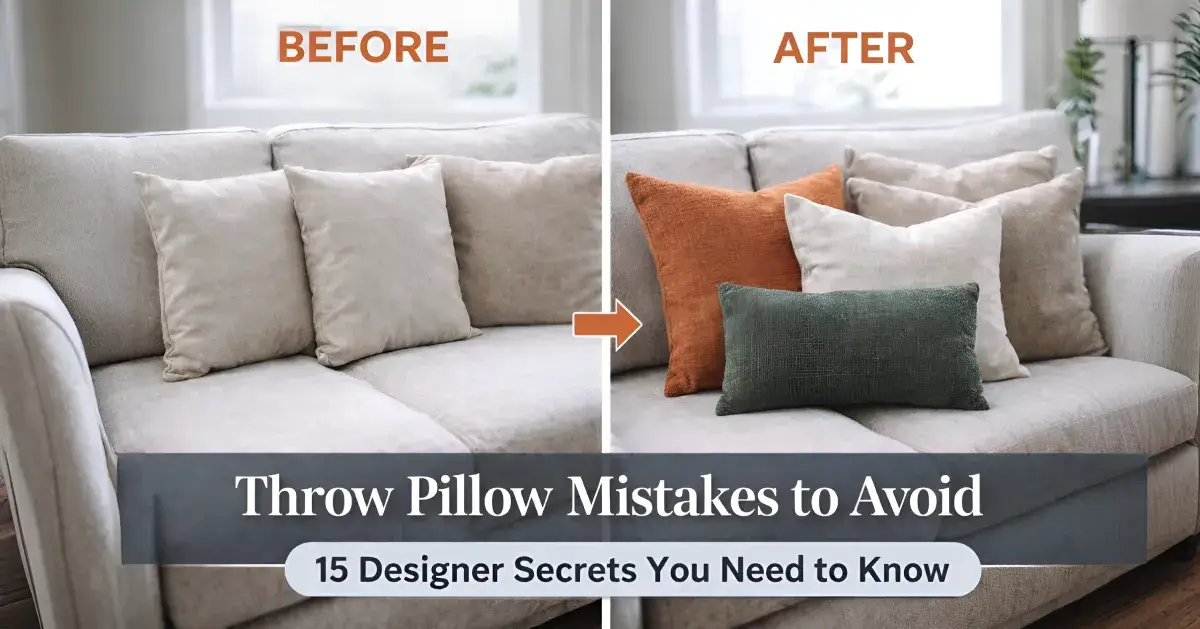
You've rearranged your sofa three times. You've tried every combination. You've spent hours adjusting the corners, fluffing the inserts, and staring at the setup from across the room. Something still looks wrong, but you can't quite identify what it is. If this frustrating experience sounds familiar, the answer is almost certainly in your throw pillows—or more specifically, in the subtle styling errors that even experienced decorators make without realizing it.
Throw pillows are simultaneously one of the easiest and most deceptively complex elements of interior design. Done right, they tie a disparate room together, inject personality, introduce vital texture, and signal design confidence. Done wrong, they can make even the most expensive, beautifully crafted furniture look discount, dishevelled, and poorly considered. The gap between these two outcomes is much narrower than you might think.
In this comprehensive guide—informed by the precise principles that professional interior stylists use every day—we break down the 15 most common throw pillow mistakes to avoid, complete with an instant quick-fix for every single one. Whether you are a first-time decorator setting up a new apartment or an experienced home stylist looking for that final polished edge, correcting at least one of these missteps will change how you see and style your space today.
Mistake #1 – Using Pillows That Are All the Same Size
When every pillow on a sofa is identical in size—say, five standard 18×18 squares lined up in a neat row—the arrangement looks inherently retail, not designed. It is the visual equivalent of a department store display rather than a curated, lived-in home. Size variation is precisely what creates the layered, dimensional, and dynamic look you see in professional interior photography and high-end shelter magazines.
Most people fall into this trap because they buy matching sets from the same store, which naturally yields identical sizes. It feels highly logical—a matching set should work together flawlessly, right? But professional stylists almost never use matching sets wholesale. A uniform height across your sofa back creates a rigid horizontal line that prevents the eye from moving comfortably through the space.
A well-styled sofa should have at minimum two different sizes. The most versatile, foolproof combination is a large base size (20×20 or 22×22) paired with a slightly smaller accent square (18×18) and a rectangular lumbar pillow (12×20) to anchor the very center of the arrangement.
The Fix: Add one lumbar pillow in a complementary color or pattern. It instantly creates visual variation and breaks up the uniform height without requiring a complete overhaul of your existing setup.
Mistake #2 – Choosing the Wrong Size for Your Sofa
Scale is absolutely everything in interior design. A delicate 16×16 pillow placed on a massive, overstuffed sectional looks like a postage stamp lost on an envelope. Conversely, a giant 24×24 pillow on a petite vintage loveseat swallows the seating space entirely and leaves no room for a person to sit comfortably. The size of your pillows must be rigorously proportional to the physical scale of your furniture—not just to your personal aesthetic preference.
Deep-seat sofas (typically measuring 36 to 42 inches in depth) demand larger pillows because the vast seat depth visually dwarfs a standard 18×18 cushion. Standard sofas (30 to 34 inches deep) work best with an 18×18 to 20×20 as the primary base size.
Armchairs are perhaps the most common victim of oversizing. An armchair typically needs a single 18×18 square or a discrete lumbar pillow at the most. Anything larger looks incredibly awkward, forcing guests to move the pillow to the floor just to sit down.
The Fix: Measure your sofa's seat depth. If it is 36 inches or deeper, your base pillow size should be 22×22 minimum. Refer to our complete Throw Pillow Size Guide for exact recommendations by furniture type.
Mistake #3 – Using a Same-Size Insert as Your Cover
This is undoubtedly the number one reason pillows look flat, saggy, and lifeless in a living room—even when the cover is beautiful, handmade, and highly expensive. When the insert is the exact same dimension as the cover (e.g., an 18×18 insert inside an 18×18 cover), the corners go empty and pointy, the center collapses under its own weight, and the entire pillow looks deflated.
The ironclad designer's rule is this: Always buy an insert that is 1 to 2 inches LARGER than your cover. An 18×18 cover explicitly needs a 20×20 insert. A 20×20 cover explicitly needs a 22×22 insert. The slightly oversized insert fights against the boundaries of the fabric, filling every corner completely and creating that plump, luxurious, hotel-quality appearance.
Online listings rarely specify “size up your insert,” which is why this mistake is so widespread. Manufacturers sell inserts in identical sizes to their covers because it's mathematically logical—they physically fit. But “fitting” is definitely not the same as “looking perfect.”
The Fix: Replace every insert with one that is 2 inches larger in both dimensions. This single structural change will have a more dramatic visual impact than buying entirely new covers.
Mistake #4 – Pairing a Premium Cover with a Budget Insert
You can easily spend $150 on a beautifully hand-embroidered tropical pillow cover and completely destroy its visual effect by stuffing it with a $4 bargain-bin poly-fill bag. The insert is the absolute structural foundation of the pillow. A cheap, low-density poly-fill clumps violently after the first week of use, feels terribly lumpy, and makes your expensive cover look like a sad, misshapen pillowcase.
The investment ratio principle dictates that you should spend proportionally. If your cover cost $30 to $60, invest in a $15 to $25 down alternative or microfiber cluster insert. If your cover cost $80 to $150, you should put at least $35 to $50 into a high-quality down or premium memory-cluster fill insert.
A plump, quality insert not only looks vastly better—it feels deeply inviting to touch. Throw pillows are highly tactile objects; guests will invariably reach out, lean on, and hold them. What they feel directly affects their subconscious perception of your entire room's quality.
The Fix: Replace your clumpy poly-fill inserts with a down alternative or microfiber cluster fill that is 2 inches oversized. The transformation in both look and feel is instant and remarkable.
Mistake #5 – Buying a Perfectly Matching Pillow Set
The perfectly coordinating four-pillow set—where every single pillow exists in the exact same fabric, print, and color family—is the distinct hallmark of a room that was decorated in a single afternoon and hasn't been thoughtfully touched since. While it looks complete and satisfying on the store shelf or catalog page, in your living room, it reads as flat, one-dimensional, and almost aggressively coordinated.
Professional stylists aim for a look that feels genuinely collected over time. You want an arrangement that appears as if each pillow was found on a different trip, sourced from a different boutique, and brought together by a highly discerning eye rather than rapidly added to a digital cart all at once. This is the critical distinction between a room that is “curated” versus one that is merely “decorated.”
To successfully break the set, keep one or two pieces from your matching collection and supplement them with contrasting textures (like velvet, woven rattan, or heavy linen) alongside one distinctly different pattern that shares only a single unifying color with the others.
The Fix: Take two pillows from your matching set, add one solid in a highly contrasting texture (velvet, boucle, or linen), and one patterned pillow in a vastly different scale. Four items become a curated grouping rather than a retail set.
Mistake #6 – Neglecting Texture Entirely
A row of pillows constructed in the exact same fabric—even if they feature brilliantly varied colors and patterns—has absolutely no tactile dimension. Texture is the secret ingredient that makes a pillow arrangement feel exceptionally rich, layered, and inviting from clear across the room. Distinct textures catch the ambient light differently, create subtle shadow play, and add a profound depth that color alone simply cannot provide.
Successful texture combinations rely on contrast: pairing a smooth cotton botanical print with a woven rattan Jacquard and a plush velvet solid, or a relaxed linen print accented with heavy embroidery and a chunky cable knit.
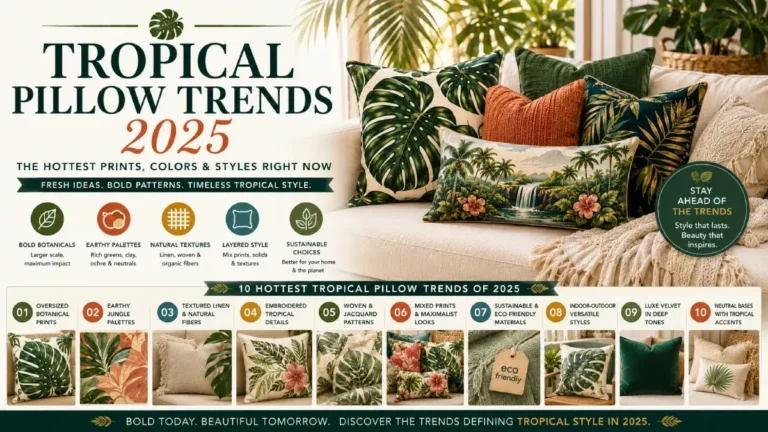
Tropical pillow styling particularly benefits from texture mixing because tropical design is inherently multi-layered and wild—just like the actual jungle environment it emulates. Placing a highly woven palm-leaf texture alongside a smooth, digitally printed monstera leaf creates that naturalistic, deeply layered quality that brings the aesthetic to life.
The Fix: Add one heavily woven or textured pillow—such as a rattan weave, raised Jacquard, or velvet emboss—to every existing arrangement. You don't need to replace anything; just add one deeply tactile element.
Mistake #7 — Using an Even Number of Pillows
Placing two or four identical pillows on a sofa creates absolute perfect symmetry—which sounds highly desirable until you realize that perfect symmetry in standard home decor often reads as static, stiff, and uninteresting. The human eye intrinsically craves a focal point, a visual journey, and a slight sense of tension. Even numbers rarely provide this engaging dynamic.
The psychology of odd numbers dictates that three or five pillows allow for a natural visual hierarchy: one dominant statement piece, two supporting anchors, and optionally one contrasting accent at the front. This configuration creates visual movement and invites the eye to naturally travel across the arrangement rather than seeing it as a closed, mirrored unit.
Strict symmetry does function well in highly formal, traditional rooms—a pair of matching pillows on a symmetrical Chesterfield sofa, for example, is classic and highly intentional. The operative phrase here is intentional: symmetry should be a deliberate, formal design choice, not a default result of merely buying pillows in pairs.
The Fix: If you currently have four pillows, add a single lumbar pillow in the center front. You now have five pillows with a natural focal point and an immediate, tremendous visual improvement.
Mistake #8 — Selecting Pillows Without Pulling from the Room's Existing Palette
Pillows that exist entirely in their own color world—completely unconnected to the area rug, the artwork, the curtains, or the wall color—feel like unwelcome interlopers. They don't harmonize with the space; they aggressively compete with it. A set of bright, electric turquoise tropical pillows in a room dominated by warm terracotta walls and rust-toned leather furniture will look jarring and chaotic rather than refreshing.
Professional stylists adhere strictly to the “pull one color” rule. They select pillows that contain at least one specific color already prominently present in the room. If your vintage area rug features a subtle thread of coral, your new tropical pillow's coral accent will instantly feel anchored and intentional. The pillow should extend the room's existing palette, not introduce an entirely foreign one.
Pattern picking by using a color bridge is a foolproof strategy. A botanical tropical print incorporating sage green, ivory, and dusty coral is immensely versatile because it bridges both cool and warm tones. If your room features ANY of those colors—in any proportion—the pillow will feel inherently connected.
The Fix: Hold a potential pillow next to your existing rug, artwork, or curtains. If you cannot identify at least one directly shared color, put it back. The bridge color is what connects the entire room.
Mistake #9 — Styling a Sofa Without a Lumbar Pillow
The lumbar pillow is the ultimate secret weapon of professional pillow arrangements. It introduces a completely different geometric shape to a monotonous group of squares, creates a natural, undeniably appealing center focal point, and functions as an organic “anchor” for the entire sofa setup. Without it, sofa styling frequently feels like it's missing something vital—because it is.
The lumbar sits proudly at the front-center of the arrangement, noticeably shorter and wider than the surrounding standard squares. It deliberately breaks the visual monotony of uniformly shaped cushions and draws the eye naturally toward the direct center of the seating area—which is exactly where you want a guest's focus to land.
In tropical applications, a horizontal lumbar featuring a lush tropical print (such as a sweeping palm frond or a single, elegant Bird of Paradise stem) is particularly effective. Its wide format uniquely allows the print's full, sprawling composition to be seen in its entirety, rather than being awkwardly cropped into a restricted square.
The Fix: Add one 12×20 or 14×22 lumbar pillow to the exact center of your sofa, in a solid color or subtle pattern that bridges between your existing squares. It costs little and delivers an immediately elevated result.
Mistake #10 — Using Indoor Pillows Outdoors (or Vice Versa)
This mistake is especially prevalent in tropical-style decorating, where the exact same lush palm leaf print might appear in both indoor and outdoor collections. Indoor pillow fabrics—such as raw cotton, fine linen, and delicate velvet—are physically designed to absorb moisture gently as indoor humidity fluctuates in a temperature-controlled room. Placed outdoors, that unchecked absorption means deep mold penetration within days and catastrophic dye breakdown within weeks.
The reverse problem is also true: Using outdoor-grade pillows inside your living room isn't dangerous, but it is a distinct waste of resources. Solution-dyed acrylic (like premium Sunbrella) has a slightly stiffer, more synthetic hand-feel compared to exquisitely soft cotton or washed linen. Indoors, where hardcore weather resistance is irrelevant, you are paying a massive premium for a functional feature you do not need, while sacrificing optimal comfort.
UV damage outdoors is far more aggressive than most homeowners realize. A single full summer of direct, unyielding sun exposure will aggressively bleach a standard indoor cotton pillow beyond recognition—even if it is placed on a deeply covered porch that only receives indirect afternoon sun.
The Fix: If a pillow will live outdoors for more than a few hours, it absolutely must be a purpose-built outdoor pillow utilizing solution-dyed or Sunbrella fabric.
Mistake #11 — Using Too Many Pillows
More pillows does not inherently equal more style. Beyond a certain threshold—typically six or seven pillows on a standard three-seat sofa—the arrangement crosses over from styled to physically uncomfortable. Guests are forced to sheepishly remove pillows and place them on the floor just to sit down, and the arrangement becomes visually chaotic. The individual pillows cease being stylish accents and morph into an impenetrable wall of fabric.
You can easily diagnose this with the “no seating left” test: Stand back and look squarely at your sofa. Can you easily identify three comfortable, unobstructed seating positions that do not require displacing a pillow? If not, your arrangement has become excessive.
This mistake often stems from a cultural overcorrection—the lingering idea that overwhelming abundance equals luxury. In reality, the highly coveted, serene luxury hotel look that people are attempting to replicate is typically achieved with 5 to 7 meticulously chosen pillows, not 12 randomly selected, overflowing ones.
The Fix: Remove pillows one by one until you have an odd number (3 or 5 for a standard sofa, 5 or 7 for a large sectional) and you can clearly see three distinct seating positions. Store the removed pillows in a closet for seasonal rotation.
Mistake #12 — Never Maintaining Your Pillows
Even the most perfectly chosen, expertly arranged throw pillows will inevitably look sad and deflated if they are absolutely never maintained. Poly-fill naturally clumps toward the bottom due to gravity. Real down gradually settles. Covers inevitably wrinkle and crease in one direction from being leaned against. Within a few weeks, what was once a beautiful, voluminous arrangement becomes a flat, lumpy display.
Professional stylists implement a rigid maintenance routine. Every few days, they grab each pillow and shake it vigorously to redistribute the internal fill evenly. For down and down-alternative fills only, they press a firm indent into the top center of the pillow with the side of their hand. This creates the highly desired, hotel-style “karate chop” that visually signals freshness and meticulous care. Additionally, they rotate and flip pillows 180 degrees weekly to prevent one side from compressing more than the other.
Seasonal care is also paramount. Every 3 months, remove the covers and wash them according to their specific fabric instructions. Concurrently, air the inserts outdoors in the fresh breeze for a few hours to reinvigorate them. This incredibly simple practice dramatically extends the lifespan of your investment.
The Fix: Spend exactly 2 minutes fluffing and karate-chopping your pillows every single time you straighten up your living room. The maintenance time required is minimal; the visual impact is significant.
Mistake #13 — Making It Look Too “Put Together”
This is the great, somewhat frustrating paradox of throw pillow styling: you can genuinely try too hard. When every pillow, every throw blanket, every side table book, and every decorative object is flawlessly, perfectly color-coordinated down to the last microscopic hue, the room stops feeling like a welcoming home and starts feeling like an intimidating showroom floor. It reads as clinically manufactured rather than warmly lived-in.
The principle of “curated imperfection” is what saves a room. The most inviting spaces possess a slight sense of unique personality and mild imperfection—a pillow that is styled slightly off-center, a bold mix of patterns from entirely different style eras, or a highly rugged texture that doesn't quite “match” but definitely belongs there. This tension is the exact difference between a room that looks stiffly “decorated” and one that looks masterfully “designed.”
In tropical pillow styling, this means fearlessly mixing your highly refined botanical print (the “polished” element) with a much rougher, thick woven rattan texture (the “natural” element) and perhaps a remarkably simple, classic cotton stripe (the “grounding” element). Three vastly different design languages working cohesively together feel far more natural—and authentic to the tropics—than three perfectly matching pillows.
The Fix: Deliberately choose at least one pillow that surprises you slightly—a different style era, a heavily contrasting texture, or a slightly unexpected accent color. The slight tension is exactly what makes the arrangement feel curated rather than purchased from a catalog.
Mistake #14 — Mismatching Print Scale to Pillow Size
Applying a massive, sprawling palm frond print onto a tiny 14×14 mini pillow means the design will be completely cropped and unreadable—you will just see a confusing, abstracted blur of green. Conversely, applying a highly delicate, tiny all-over ditsy print onto a massive 24×24 oversized pillow looks intensely busy and visually overwhelming. Print scale must be thoughtfully matched to the physical size of the pillow.
As a general scale guide: Small prints (tiny dots, micro-geometrics, mini florals) work best on small 12×20 lumbars or 14×14–16×16 accent pillows. Medium prints (standard leaves, mid-size geometrics) are ideal for standard 18×18–20×20 sizes. Large-scale prints (oversized botanicals, full towering palm trees, dramatic Bird of Paradise flowers) desperately need 20×20 to 24×24 pillows to properly showcase the full, uncropped repeat of the pattern.
The most spectacular tropical prints—large-scale monstera leaves, sweeping banana palm fronds, dramatic floral stems—MUST be placed on pillows 20×20 or larger. Below that dimensions, the artist's original design is simply cropped into meaninglessness.
The Fix: Before buying, ask for or check the ‘print repeat' measurement. If the repeat is larger than 12 inches, you definitively need at least a 20×20 pillow. A 14-inch print on a 16×16 pillow will show less than one full design repeat.
Mistake #15 — Buying All Your Pillows from the Same Store
If every single pillow on your sofa comes from the exact same major retail store, the same seasonal collection, and the same catalog page—they will look like they belong to each other in the most obvious, retail-floor way possible. The “all from one source” approach is incredibly easy to identify from across the room, and it subtly signals a distinct lack of intentional curation and design effort.
Professional stylists rigorously employ a multi-source strategy. They might combine a durable Sunbrella cover from a specialty outdoor retailer, a luxurious velvet accent sourced from a high-end local boutique, a custom handmade botanical print found on Etsy, and a crisp, simple stripe from a mass-market high-street brand. All of these disparate elements are expertly brought together by a unifying color story and careful attention to scale and varied texture.
Diversify your sourcing. Look to boutique Etsy shops for unique, artisan covers. Scour end-of-season clearances at major retailers for investment-quality foundation pieces. Check vintage and thrift stores for surprising textiles, and rely on department stores for your reliable, solid-color anchors.
The Fix: The very next time you add a pillow to your collection, deliberately choose it from a source or retailer you haven't used before. The diversity of provenance is precisely what creates the ‘collected over time' quality that defines genuinely great pillow styling.
The 15 Throw Pillow Mistakes at a Glance
| Mistake | The Quick Fix |
|---|---|
| All same size | Add a lumbar for instant variation |
| Wrong size for furniture | Base size = 20×20 for standard sofas |
| Same-size insert as cover | Always size up insert by 2 inches |
| Cheap insert, expensive cover | Spend proportionally to cover cost |
| Matching set only | Break it up with 1 contrasting texture |
| No texture variation | Add one woven or velvet element |
| Even number, no focal point | Add a lumbar for an odd-number total |
| Colors disconnected from room | Pull at least 1 color from existing room |
| No lumbar pillow | Add 1 lumbar as a center focal point |
| Indoor pillows used outdoors | Use solution-dyed outdoor fabrics only |
| Too many pillows | Remove down to 3 or 5 (odd number) |
| Never maintaining pillows | Fluff, rotate, and karate-chop weekly |
| Over-coordinated | Add 1 deliberate “surprise” element |
| Print scale mismatch | Match large prints to 20×20+ pillows |
| One-source shopping | Diversify with Etsy, boutiques, thrift |
Frequently Asked Questions
What is the number one throw pillow mistake?
Using a same-size insert as the cover. This is the single most impactful error because it produces flat, lifeless, and saggy pillows regardless of how beautiful or expensive the exterior cover is. Always size up your insert by 1 to 2 inches to guarantee a plump, professional result.
How many throw pillows is too many?
For a standard 3-seat sofa, more than 6 pillows typically crosses the line into overcrowding territory. The ultimate test: can you identify 3 comfortable seating positions without having to move or displace any pillows? If not, you have too many.
Should throw pillows match the sofa?
They should thoughtfully relate to the sofa's color, but they should not match it precisely. Pull one key color from your sofa and subtly echo it in your pillows (or pull a highly contrasting accent if your sofa is a flat neutral). Perfect matching simply looks flat and uninspired.
Is it wrong to mix patterns on a sofa?
No—thoughtful pattern mixing is precisely what separates a brilliantly designed room from a hastily decorated one. The golden rule is to vary the scale (e.g., one large print plus one medium print plus one small print or solid) and ensure they share at least one unifying color across all patterns.
Can I use the same pillows year-round?
Yes, if you purposefully choose highly versatile colors and durable fabrics. However, many professional decorators use a seasonal cover strategy over permanent, high-quality inserts—keeping the exact same luxury inserts year-round and merely swapping the exterior covers as palettes shift from spring/summer tropical vibes to autumn/winter warm, cozy tones.
Do expensive pillows make a difference?
Quality inserts make the most profound difference—a $20 premium down-alternative insert placed inside a $15 cover will look immeasurably better than a $5 cheap poly-fill stuffed inside a $100 designer cover. Invest in the structural insert first, and then focus on the decorative cover.
Style Confidently — Now That You Know What to Avoid
Masterful throw pillow styling is part cultivated instinct and part rigid knowledge. Now that you are armed with the core knowledge—the fundamental size rules, the absolute truth about inserts, the texture variation principle, and the pattern-scale relationship—the creative instinct will follow much more naturally. The 15 mistakes outlined here are incredibly common; they are simply what happens when well-meaning decorators attempt to work without a solid foundational framework.
Use this comprehensive guide as your definitive framework. Return to it every single time you are about to add a new pillow to your home or rearrange your sofa. Over time, applying these principles will become entirely second nature—and your living spaces will beautifully reflect that high-level design confidence. Explore our complete guides below to take the next crucial step in your tropical pillow styling journey.