There is a particular kind of disappointment that comes with pulling a beloved tropical pillow from its storage bag at the start of summer only to find the monstera print faded to a ghost of its original vibrancy, or the dark botanical background streaked with the pale evidence of improper washing. Tropical throw pillows — with their bold botanical prints, saturated dyes, dark backgrounds, and often intricate embroidery or jacquard weaves — require a more thoughtful care approach than the plain linen or solid-color pillows that standard care guides address. The same qualities that make them visually striking also make them vulnerable: deep, saturated dyes have a higher bleeding risk; dark backgrounds reveal fading more dramatically than lighter fabrics; and the complex print structures used in high-quality tropical textiles demand gentler handling than budget-grade poly blends.
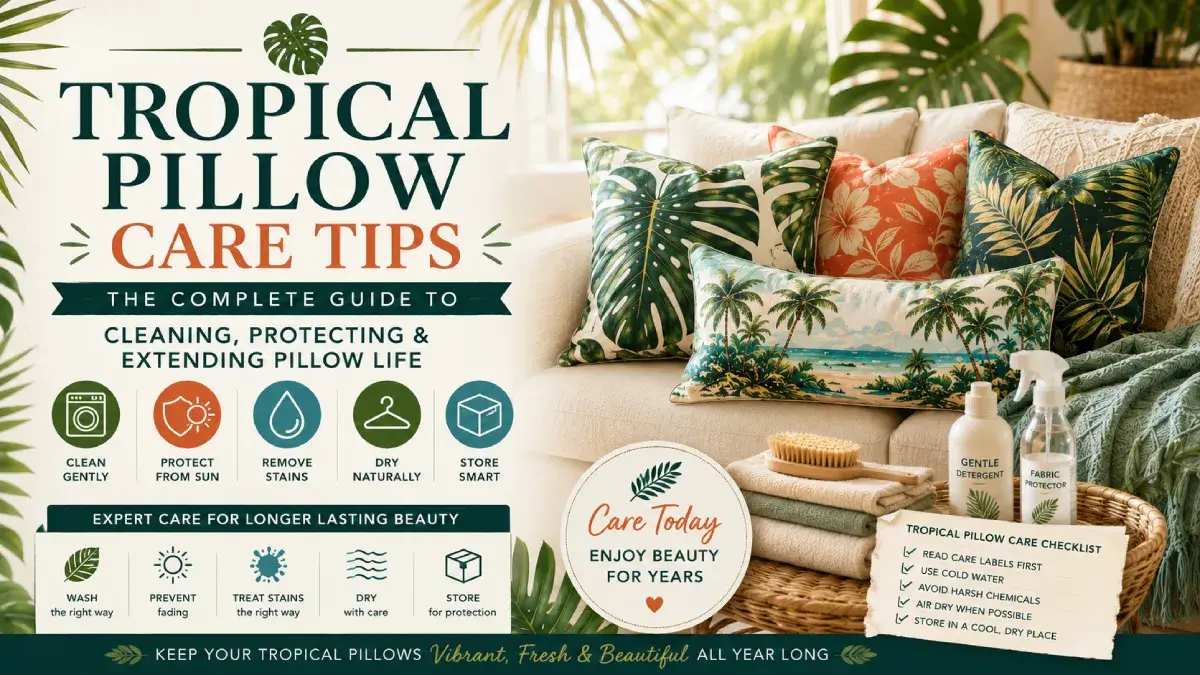
This comprehensive tropical pillow care guide covers every scenario you are likely to encounter — machine washing, hand washing, stain removal, outdoor pillow maintenance, UV fading prevention, and end-of-season storage. Follow these recommendations and your tropical pillow collection will maintain its vibrancy through multiple summers, delivering a return on investment that makes even premium-priced covers well worth their cost.
| Task | Recommendation |
|---|---|
| Washing | Cold Water Only |
| Drying | Air Dry Preferred |
| Bleach | Never Use Chlorine |
| Outdoor Care | Clean Monthly |
| Storage | Cotton Bag + Cedar Block |
Why Tropical Pillows Need Special Care
Understanding why tropical pillows are more care-intensive than standard throw pillows makes it easier to apply the right techniques consistently. The challenges are specific and predictable — and entirely manageable once you know what you are working against.
Bold, saturated tropical dyes — the deep greens of monstera prints, the vivid corals of hibiscus patterns, the rich navy backgrounds of maximalist botanical designs — are achieved with higher concentrations of dye than lighter or muted fabric colorways. Higher dye concentration means a greater risk of color bleeding during the first several washes, particularly when hot water or agitation loosens the dye bonds. Dark backgrounds compound this issue: while a cream or white fabric can absorb minor fading with minimal visible impact, a near-black botanical background will show fading starkly and immediately, often developing an uneven, patchy appearance after just one improper wash.
Outdoor tropical pillows face an entirely different set of stressors. UV-A and UV-B radiation breaks down the molecular dye bonds in printed fabrics over time, with the speed of degradation determined primarily by whether the color is surface-printed (fast to fade) or solution-dyed into the fiber itself (slow to fade). Salt air near coastal properties accelerates oxidation of dye compounds. High humidity creates conditions favorable to mildew, particularly inside foam or poly-fill inserts that have absorbed moisture. Embroidered and jacquard tropical prints add a further layer of complexity — the raised threads and woven structures that create their dimensional quality are vulnerable to snagging, pilling, and distortion under aggressive washing conditions.
Pro Tip: The Care Label Rule
Always read the care label sewn into your pillow cover before the first wash — it overrides all general advice, including everything in this guide. Manufacturers test their specific fabric-dye-print combinations and encode the results in that small label. A care label recommending dry clean only on an embroidered silk cover is not a suggestion — it is the difference between a pristine pillow and a ruined one.
Reading Pillow Care Labels
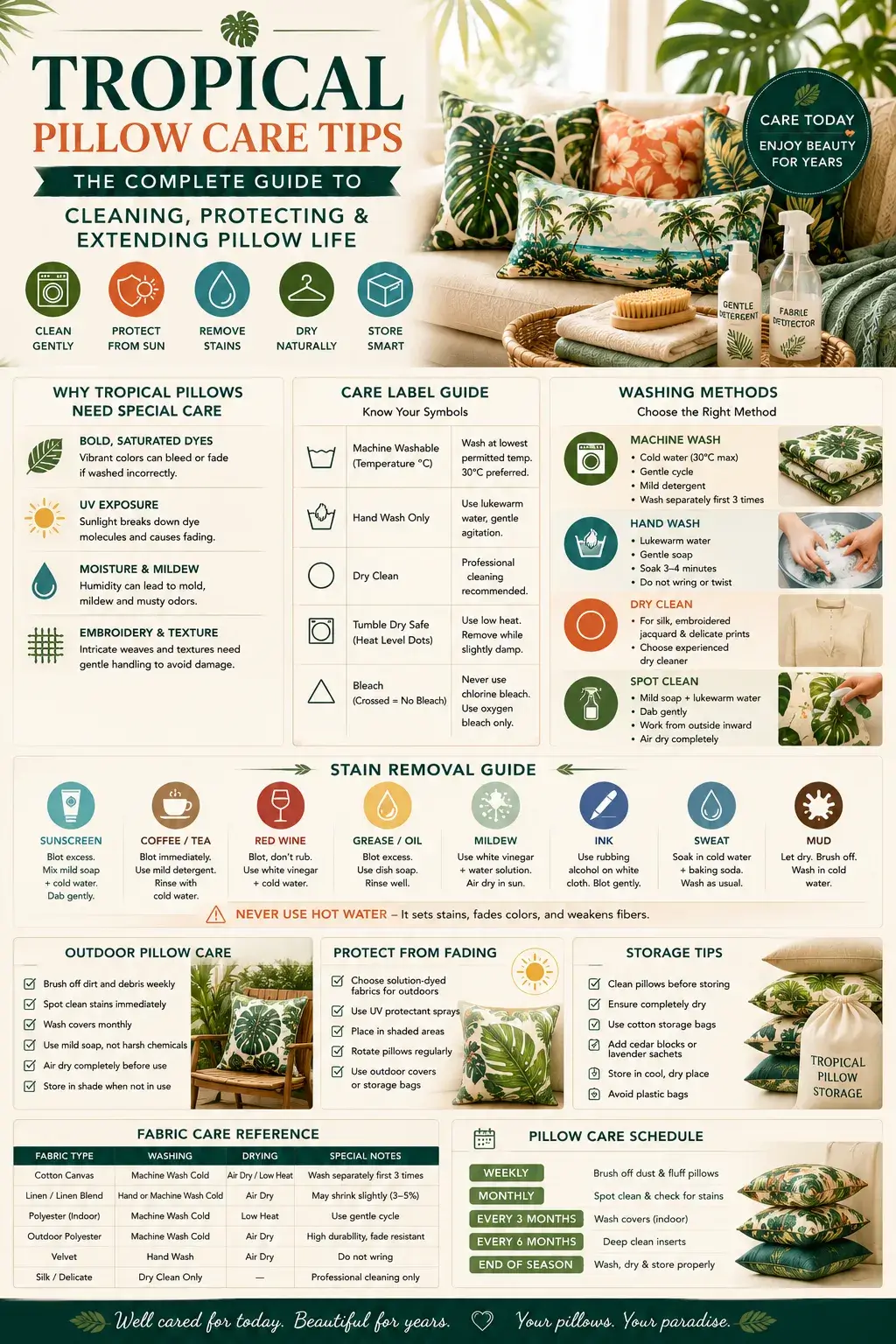
The international care symbol system uses five standardized icons to communicate washing, drying, dry cleaning, ironing, and bleaching instructions. For tropical pillow covers specifically, each symbol carries additional implications beyond the basic instruction.
| Symbol | Meaning | For Tropical Prints: What to Do |
|---|---|---|
| Tub with water (washing tub) | Machine washable — number inside indicates max temperature in °C | Always wash at the lowest permitted temperature (30°C preferred); use color-safe detergent; gentle cycle only |
| Hand in tub | Hand wash only — do not machine wash | Use lukewarm water max 30°C; minimal agitation; press gently to remove water — never wring or twist |
| Circle (dry cleaning) | Dry clean; letter inside indicates permitted solvent type | Take to a professional cleaner experienced with printed textiles; mention the dye type if known |
| Square with circle (tumble dry) | Tumble dryer safe; dots inside indicate heat level (1 dot = low, 2 = medium) | Always use low heat for tropical prints; remove while slightly damp to prevent shrinkage; never high heat |
| Triangle (bleaching) | Bleach permitted; crossed triangle = no bleach of any kind | Never use chlorine bleach on tropical prints regardless of symbol — use oxygen bleach only if triangle is clear |
When in Doubt
When the care label is missing, faded, or illegible — hand wash in cold water. It is always the safest approach for any tropical print fabric, regardless of fiber content. Cold water hand washing generates no heat (which locks stains) and minimal mechanical agitation (which distorts prints and loosens dye bonds). It will never make things worse; aggressive machine washing often will.
Washing Tropical Pillow Covers
Different tropical pillow fabrics require different washing approaches. Using the wrong method — even once — can permanently damage a print or distort a cover's shape. The four methods below cover the full spectrum of tropical pillow cover types.
Machine Washing (SAFE)
Best for: Cotton canvas, cotton-linen blends, performance polyester, outdoor-rated fabrics
- Zip all zippers fully closed before loading — open zippers snag and damage other covers.
- Place covers inside a mesh laundry bag to prevent print abrasion against the drum.
- Select cold water (30°C maximum) and the gentle or delicate cycle — never normal or heavy.
- Use a color-safe, fragrance-free liquid detergent; avoid powder detergents that leave residue in dark prints.
- Wash tropical prints separately from light-colored laundry for the first three washes — dye bleeding risk is highest when covers are new.
- Do not overload the machine — covers need room to move freely without excessive friction.
Hand Washing (SAFE)
Best for: Velvet, embroidered cotton, jacquard weaves, silk blends
- Fill a clean basin or bathtub with lukewarm water — not hot, not cold. Aim for body temperature.
- Add a small amount (one teaspoon) of gentle liquid soap or wool wash; swirl to dissolve fully before adding the cover.
- Submerge the cover and move it gently through the water for 3–4 minutes — no scrubbing, no twisting.
- Drain and refill with clean cold water; repeat gentle movement to rinse. Repeat until no soap remains.
- To remove water: lay the cover flat on a clean dry towel, roll the towel up with the cover inside, and press firmly. Unroll and lay flat to dry. Never wring, twist, or squeeze forcefully.
Dry Cleaning (Caution — Professional Only)
Best for: Silk, heavily embroidered covers, beaded or sequined tropical prints, complex jacquard with metallic thread
When the care label specifies dry cleaning, there is no DIY workaround that is safe for the fabric. Dry cleaning solvents dissolve oils and soils that water cannot reach without the mechanical agitation that damages delicate weaves and embroidery. Choose a dry cleaner experienced with printed textiles and point out any specific areas of concern — stains, loose threads, or areas where the print shows stress. Ask them to treat colors as vulnerable and request cold pressing rather than steam pressing if ironing is required after cleaning.
Spot Cleaning (SAFE)
Best for: Quick refresh, outdoor performance covers, between full washes
- Mix one teaspoon of mild dish soap or upholstery cleaner with one cup of lukewarm water.
- Dampen a clean white cloth (never colored — color can transfer) with the solution.
- Work from the outside edge of the stain inward using gentle circular motions — never scrub back and forth, which spreads stains and damages print fibers.
- Blot dry with a clean dry cloth; air dry completely before replacing on insert.
- For outdoor Sunbrella or performance fabrics, a soft-bristle brush is acceptable for removing embedded debris before spot treatment.
⚠ Never Use Hot Water on Tropical Pillow Covers
Hot water is the single most destructive force for tropical pillow prints. Heat denatures the polymer bonds between dye and fiber, permanently locking stains into the fabric, causing color bleeding between print areas, and accelerating the irreversible fading of dark backgrounds. Even one hot-water wash can visibly age a high-quality tropical cover by the equivalent of two to three seasons. Always cold or cool water — no exceptions.
Washing Pillow Inserts
Pillow covers receive most of the care attention, but inserts accumulate dust, body oils, and moisture over time and require periodic cleaning too. The correct method depends entirely on the fill type — and using the wrong approach can destroy an insert irreversibly.
Down & Feather Inserts
Machine wash warm on gentle cycle. Use a small amount of down-specific detergent — regular detergents strip the natural oils that give down its loft. Add two clean tennis balls to the dryer on low heat to break up clumping as the down dries. Tumble dry completely — this typically takes 2–3 dryer cycles. Down that is even slightly damp when replaced in a cover will develop mildew within 48 hours.
Poly-Fill Inserts
Machine wash cold on gentle cycle with a small amount of mild liquid detergent. Tumble dry on low heat — poly-fill dries faster than down and can be checked after a single 45-minute cycle. Fluff by hand while still warm from the dryer to redistribute fill evenly and restore loft. Poly-fill inserts are the most forgiving to wash and the most affordable to replace if damaged.
Memory Foam & Latex Inserts
Spot clean only — never submerge memory foam or latex in water. The cellular structure of these materials absorbs liquid deeply and takes days to dry fully in normal conditions, creating ideal conditions for mold and mildew growth inside the pillow. For surface soiling, mix mild soap with water, apply with a damp cloth, blot clean, and allow to air dry completely in a well-ventilated area before use.
⚠ The Damp Insert Warning
A damp pillow insert placed inside a cover — even a slightly damp one — will develop mold and mildew within 48 hours in normal indoor conditions. The cover traps moisture against the insert, creating a sealed, warm, humid environment that is ideal for mold spore germination. Once mold establishes inside a poly-fill or down insert, it cannot be fully eliminated by washing. The insert must be discarded. Always ensure inserts are 100% dry — press your hand firmly into the center of the insert to check the core, not just the surface — before returning them to covers.
Stain Removal Guide for Tropical Pillows
Tropical pillows are frequently used in high-traffic entertaining spaces — outdoor patios, pool decks, and casual living rooms — where stains are an occupational hazard. The key to successful stain removal is speed: a fresh stain treated within ten minutes is a manageable problem; the same stain left for an hour begins to bond chemically with the fabric fibers and becomes significantly harder to remove. Pre-treat any stain before placing the cover in the washing machine — the mechanical action of a wash cycle without pre-treatment will set many common stains permanently.
Pro Tip: The 10-Minute Rule
Act within 10 minutes of any spill on a tropical pillow cover. Fresh stains typically remove completely in 1–2 treatments using the correct method. The same stain left to dry requires 5–10 treatments and may still leave a ghost mark. Keep a small spray bottle of diluted mild dish soap near any high-use tropical pillow arrangement — it is the most universally effective first-response stain treatment available.
| Stain Type | Best Treatment | Products to Avoid | Outcome |
|---|---|---|---|
| Sunscreen | Dish soap + cold water; pre-treat 15 min before washing. Oil-based sunscreen may need a second treatment with baking soda paste first. | Hot water; bleach; enzyme cleaners (can discolor tropical dyes) | Usually Removable |
| Food & Grease | Blot immediately; apply baking soda to absorb oil (10 min); brush off; treat with dish soap + cold water; wash normally. | Rubbing with dry cloth (spreads grease); hot water | Usually Removable |
| Red Wine | Blot immediately; apply club soda or cold water; sprinkle salt to absorb; rinse cold; treat with oxygen-based stain remover before washing. | Hot water; white wine (myth — ineffective); chlorine bleach | Removable if Fresh |
| Coffee | Blot; rinse with cold water; apply mixture of dish soap + white vinegar + cold water; let sit 5 min; rinse; wash normally. | Hot water; milk (adds protein stain); scrubbing | Usually Removable |
| Mud & Dirt | Let dry completely first (crucial — wet mud smears deeper into fibers); brush off dry residue; treat remaining mark with cold water and mild soap. | Treating while wet; scrubbing wet mud | Easily Removable |
| Mildew & Mold | Brush off dry spores outdoors; treat with white vinegar solution (1:1 with water) — let sit 30 min; wash with oxygen bleach-safe detergent on cold cycle; air dry fully. | Chlorine bleach on colored covers; hot water; storing before fully dry | Removable if Caught Early |
| Sweat & Body Oil | Pre-soak in cold water + baking soda (30 min); treat with enzyme-based laundry pre-treatment; wash cold gentle cycle. | Hot water (sets protein stains permanently); chlorine bleach | Removable with Pre-Treatment |
| Ink | Apply isopropyl alcohol (70%) to a white cloth; blot — do not rub; continue with fresh cloth sections until no ink transfers; rinse cold; wash normally. Test in hidden spot first. | Water first (spreads ink); hot water; scrubbing | Difficult — May Not Fully Remove |
Drying Tropical Pillows Properly
Drying is where the majority of pillow cover damage occurs. The combination of heat (which shrinks natural fibers and degrades synthetic dyes), mechanical tumbling (which pills fabric surfaces and distorts embroidery), and incorrect positioning (which creates permanent creases and uneven drying) turns an otherwise successful wash cycle into a damaging one. Air drying is always the safest option for tropical prints; machine drying is acceptable for cotton canvas and performance polyester on low heat only.
1. Reshape Immediately After Washing
Remove the cover from the washing machine as soon as the cycle ends — never leave wet covers sitting in the drum. While the fabric is still damp, gently pull it back into its correct shape with your hands: square corners square, seams straight, zipper area flat. Reshaping while wet takes ten seconds and prevents permanent distortion that would require ironing to correct.
2. Lay Flat on a Clean Towel or Drying Rack
Flat drying is the gold standard for tropical pillow covers. Place the cover print-side down on a clean, dry white towel (color towels can transfer dye to damp fabric) or on a flat mesh drying rack. Flat drying prevents the gravitational stretching that occurs when covers are hung from one edge, which distorts the fabric and shifts the print alignment on printed covers.
3. Flip After 2–3 Hours for Even Drying
After the top surface has dried to the touch (typically 2–3 hours in normal indoor conditions), flip the cover over so the previously face-down side can dry fully. Without flipping, the bottom surface retains moisture significantly longer and can develop a musty odor even if the top appears dry. The center of the cover dries slowest — press your hand into the middle to confirm complete dryness before moving to the next step.
4. Replace Insert Only When Cover Is Fully Dry
This step is non-negotiable. Even slight residual moisture in the cover creates ideal conditions for mildew on the insert once enclosed. Test the cover by pressing it firmly against your face — you will feel any remaining coolness that indicates moisture. When the cover is genuinely room-temperature and dry throughout, it is safe to reinsert and return to use.
⚠ No Direct Sunlight Drying for Bold Tropical Prints
The instinct to dry freshly washed tropical pillow covers in direct sunlight is understandable — sun drying is fast, free, and leaves fabrics with a clean outdoor freshness. But for bold tropical prints, particularly those with dark backgrounds and saturated botanical colors, direct UV exposure during drying accelerates dye degradation at precisely the moment when the fabric is most vulnerable — when it is wet and the dye bonds are at their weakest. Always dry tropical pillow covers in shade, indoors, or under a covered porch — never in direct afternoon sun.
Caring for Outdoor Tropical Pillows
Outdoor tropical pillows operate in a fundamentally more demanding environment than their indoor counterparts. UV radiation, rain, humidity, salt air (in coastal settings), bird and insect activity, and the cumulative effects of temperature cycling all work against fabric integrity. The good news: purpose-built outdoor performance fabrics — solution-dyed acrylics, Sunbrella-grade materials, and marine-grade polyester — are specifically engineered to withstand these conditions. The key is caring for them correctly so that their engineered resistance is not undermined by improper maintenance.
After Rain: Immediate Response
When outdoor tropical pillows are caught in rain, the response in the first 30 minutes significantly affects long-term outcome. Blot the pillow surface with a dry towel — do not rub, which pushes water deeper into the fill. Stand pillows upright or prop them at an angle to drain any pooled water from seams and fill. Move to a shaded, ventilated area. Allow to air dry completely — typically 24–48 hours depending on fill thickness and humidity — before replacing on outdoor furniture. Never stack wet outdoor pillows or place them against surfaces that restrict airflow.
Weekly Maintenance Routine
A simple weekly maintenance routine prevents the accumulation of debris, surface soiling, and early mold growth that shortens outdoor pillow lifespan dramatically. Each week: shake pillows to dislodge loose debris; use a soft-bristle brush to remove any dried dirt, pollen, or insect residue from seams and fabric weave; inspect the cover surface for early mold spots (small dark specks, typically in seam areas or any spot that stays damp longest); spot-treat any mold spots immediately with diluted white vinegar before they spread. A weekly routine that takes five minutes per pillow prevents a deep-clean situation that takes two hours.
End-of-Season Deep Clean & Storage
At the end of each outdoor season (typically Labor Day in the US, or when overnight temperatures consistently fall below 50°F), outdoor tropical pillows require a full deep clean before storage. Wash all covers thoroughly; dry inserts completely; inspect for any damage that needs repair before next season. Store in breathable cotton or canvas storage bags — never in sealed plastic bins, which trap residual moisture and guarantee mildew. Add a silica gel packet or cedar block to each storage bag to manage humidity. Store in a cool, dry interior location — basements work well; attics and garages do not (extreme temperature cycling degrades even performance fabrics).
Sunbrella & Performance Fabric Care Formula
For Sunbrella, Olefin, and acrylic outdoor tropical pillow covers: mix 1 teaspoon of mild liquid dish soap with 1 quart of lukewarm water. Apply with a soft-bristle brush using circular motions. Rinse extremely thoroughly — soap residue left in outdoor fabric fibers attracts and holds dirt, accelerating re-soiling significantly. For stubborn mold or mildew on white or light Sunbrella only: a diluted bleach solution (1/4 cup bleach per gallon of water) is manufacturer- approved. Never use bleach solutions on colored Sunbrella or any dyed performance fabric — it will strip color irreversibly within seconds of contact.
UV Protection & Fading Prevention
Fading is the most common — and most irreversible — form of damage that tropical pillow prints sustain over their lifespan. Understanding the mechanism makes the prevention strategies logical rather than arbitrary. UV-A and UV-B wavelengths in sunlight attack the chemical bonds between dye molecules and fabric fibers. Each hour of direct UV exposure breaks a small number of these bonds, gradually reducing the intensity of the color. Once those bonds are broken, no amount of cleaning or treatment can restore the original color saturation.
Strategy 1: Rotate Pillow Positions Weekly
Even for indoor tropical pillows, rotating position weekly ensures that no single cover receives disproportionate UV exposure from nearby windows. A pillow sitting closest to a south-facing window receives substantially more UV than one positioned at the back of the sofa — weekly rotation spreads this exposure evenly across your collection, extending the collective vibrancy life of all your covers.
Strategy 2: UV-Blocking Window Film for Indoor Pillows
Transparent UV-blocking window film (available at hardware stores for $30–$60 per window) blocks up to 99% of UV-A and UV-B radiation while leaving visible light transmission largely unchanged. For rooms with south or west-facing windows where tropical pillows are prominently displayed, window film is the single most cost-effective fading prevention investment available — protecting not just pillows but all fabrics, wood finishes, and artwork in the room simultaneously.
Strategy 3: Fabric UV Protector Spray for Outdoor Pillows
Purpose-formulated fabric UV protector sprays (brands like 303 Fabric Guard or Scotchgard Outdoor) create an additional UV-blocking layer on outdoor performance fabrics. Apply every 3 months during active outdoor season, or after each thorough washing that removes previous applications. Follow manufacturer instructions — most require the fabric to be clean and fully dry before application, and need 24 hours to cure fully before rain exposure.
Strategy 4: Choose Solution-Dyed Acrylic for Any Outdoor Pillow
Solution-dyed fabrics have color embedded throughout the entire fiber structure — not just on the surface. This means that even when the outer surface of the fiber begins to wear, color remains visible in the fiber interior. Solution-dyed acrylic (Sunbrella is the best-known brand) carries fade warranties of up to 5 years for direct outdoor exposure. It costs more than surface-printed polyester but delivers dramatically longer color life.
Strategy 5: Store Outdoor Pillows on High-UV Days
When the UV index exceeds 8 (high to extreme) — common in summer between 10am and 4pm in most US regions — bring outdoor tropical pillows indoors or move them under shade structures. At UV index 8+, fabric degradation from a single afternoon's exposure is measurably greater than at UV index 3–5. This is especially important for any surface-printed (rather than solution-dyed) outdoor covers.
The Solution-Dyed Standard
Solution-dyed acrylic fabrics like Sunbrella are colorfast to 2,000+ hours of direct sun exposure — equivalent to roughly 5–7 outdoor summers of regular use. By comparison, surface-printed polyester outdoor fabrics typically show significant fading within a single season of full sun exposure. If you are investing in quality outdoor tropical pillow covers, solution-dyed acrylic is the only specification worth purchasing.
Seasonal Storage Guide
Improper storage destroys more tropical pillow covers than improper washing. A cover that survives multiple summers of active use can be rendered unwearable in a single off-season of storage in the wrong conditions — a damp basement, a sealed plastic bin, an unventilated attic. The five-step storage process below protects your collection across any storage period, from a two-week vacation to a full six-month winter.
1. Deep Clean All Covers and Inserts
Storage amplifies whatever condition a pillow is in when stored. A small stain becomes a set stain. A hint of mildew becomes a full infestation. A slightly dingy cover emerges from storage looking years older. Always wash all covers and inserts before storage, not after — this is the single rule that most pillow owners get backwards.
2. Dry Completely — Minimum 24 Hours Air Dry
Machine-dried covers that feel dry to the touch may still contain residual moisture in seam areas, zipper tape, and thick fabric panels. After machine drying, air dry for a minimum of 24 additional hours before packing for storage. For inserts, press into the center firmly — the core dries slowest and must be genuinely dry, not just surface-dry, before enclosing in a storage bag.
3. Add Cedar Blocks or Lavender Sachets
Natural moth and pest deterrents protect fabric covers during storage without the chemical residues and potential dye interaction risks associated with synthetic moth balls. Place one cedar block or lavender sachet per storage bag. Replace cedar blocks annually as the aromatic oils that repel moths dissipate over time — sand lightly with fine sandpaper to refresh a cedar block before reuse.
4. Use Breathable Cotton or Canvas Storage Bags
Breathable natural-fiber storage bags allow the minor moisture fluctuations that occur in any storage environment to equalize rather than accumulate. Sealed plastic bins, plastic bags, and vacuum storage bags trap humidity against fabric and create the mildew-favorable conditions that destroy covers over months of storage. Invest in proper cotton storage bags — they cost $8–$15 each and pay for themselves the first time they prevent a ruined set of covers.
5. Store in a Cool, Dry, Dark Location
The ideal storage environment for tropical pillow covers is a climate-controlled interior space: a bedroom closet shelf, a linen closet, or a climate-controlled storage room. Avoid attics (extreme heat in summer, temperature cycling year-round that stresses fibers), garages (humidity, chemical fumes from vehicles), and unfinished basements (humidity, potential flooding). Darkness protects against UV degradation even during storage; heat cycles stress fiber structures over time.
Pre-Storage Checklist
- ☑ All covers washed and fully dried (no residual moisture anywhere, including seams)
- ☑ All inserts washed and core-checked for complete dryness
- ☑ Any stains treated and removed — or noted as requiring replacement before next season
- ☑ Cedar blocks or lavender sachets placed inside each storage bag
- ☑ Covers stored in breathable cotton/canvas bags — not plastic
- ☑ Storage location confirmed as cool, dry, dark, and climate-stable (not attic or garage)
⚠ The Damp Storage Guarantee
Storing even slightly damp pillow covers or inserts in any enclosed bag or bin — breathable or otherwise — guarantees mildew growth and permanent musty odors within two to four weeks. This is not a risk; it is a certainty. Mildew spores are present in all normal air; they require only moisture, warmth, and a food source (organic fiber) to germinate. A damp storage environment provides all three. The mildew smell that results cannot be removed by washing — it is permanently embedded in the fiber structure. Prevention is the only option.
Pillow Care by Fabric Type — Quick Reference
Use this reference table to quickly identify the correct care parameters for any tropical pillow fabric type. When a specific care label differs from these general guidelines, always follow the care label.
| Fabric Type | Machine Wash | Water Temp | Dryer Safe | Bleach Safe | Typical Lifespan |
|---|---|---|---|---|---|
| Cotton Canvas | Yes | Cold (30°C) | Low Heat Only | No | 3–5 years |
| Cotton-Linen Blend | Yes | Cold (30°C) | Low Heat Only | No | 4–6 years |
| Velvet | No | Lukewarm Hand Wash | No | No | 5–8 years |
| Embroidered Cotton | Gentle Only | Cold (30°C) | No — Lay Flat | No | 4–7 years |
| Jacquard Weave | Gentle + Mesh Bag | Cold (30°C) | No — Lay Flat | No | 5–8 years |
| Performance Polyester | Yes | Cold or Warm | Low Heat | No | 3–5 years |
| Sunbrella / Solution-Dyed Acrylic | Yes | Cold or Warm | Low Heat | Light Colors Only | 5–10 years |
| Silk / Silk Blend | No | Dry Clean Only | No | No | 6–10 years (with proper care) |
How Often Should You Clean Tropical Pillows?
The right cleaning frequency balances fabric preservation (over-washing degrades fibers and dyes) with hygiene and appearance maintenance (under-washing allows soiling to set and odors to develop). The frequency guide below applies to average residential use; households with children, pets, or high entertaining frequency should increase all intervals by 30–50%.
Weekly
Fluff all pillow covers and inserts by hand to redistribute fill and restore shape. Rotate positions within the arrangement (back-to-front, left-to-right) to even out UV exposure near windows. Brush any surface debris from outdoor covers with a soft dry brush. Check for early stains or mold spots that require immediate spot treatment.
Monthly
Conduct a thorough visual inspection of all covers — front, back, seams, zipper area, corners — for any developing stains, pilling, mold spots, or print fading. Spot treat any identified issues immediately. Refresh indoor covers with a light mist of fabric freshener (diluted white vinegar in a spray bottle is effective and cost-free). Outdoor covers: spot wash seam areas where debris and moisture tend to accumulate.
Every 3 Months
Full wash cycle for all indoor tropical pillow covers using the appropriate method for each fabric type. This interval balances cleaning efficacy with fabric preservation — quarterly washing removes accumulated body oil, dust, and light soiling before it bonds permanently to fibers, while minimizing the mechanical wear and dye stress that each washing cycle introduces.
Every 6 Months / Annually
Wash all pillow inserts according to their fill type. Inspect inserts for shape retention, fill distribution, and any odor indicating mold or mildew. Apply a fresh coat of UV protector spray to any outdoor covers. Conduct the full pre-storage checklist at end of season. Assess each cover for replacement based on the replacement criteria below.
Pro Tip: Summer Outdoor Frequency
Outdoor tropical pillow covers in high-use areas — pool decks, frequently used patio seating, outdoor entertaining spaces — need washing every 4–6 weeks during active summer use. Body oil, sunscreen, food, and the cumulative effect of outdoor humidity mean these covers soil significantly faster than indoor pieces. A dedicated mid-summer wash cycle (mid-July) keeps outdoor covers looking fresh through Labor Day.
When to Replace Your Tropical Pillows
Even with impeccable care, tropical pillow covers and inserts have a finite useful life. Knowing when to replace rather than continue attempting to restore saves both time and the frustration of unsuccessfully treating damage that has moved beyond the point of recovery.
Sign 1: Permanent Stains Surviving 3+ Treatments
When a stain has been correctly treated three or more times using the appropriate method and continues to be visible, it has bonded chemically with the fabric fibers in a way that no further treatment will reverse. This most commonly occurs with set sunscreen stains, old oil stains, and ink — all of which form permanent bonds with fiber polymers when allowed to dry and cure. At this point, replacement of the cover is both more economical and more effective than continued treatment attempts.
Sign 2: Fading Beyond 50% Original Vibrancy
When a tropical pillow cover has lost more than half of its original color saturation — particularly visible in the deepest tones of a botanical print or the dark background areas of a maximalist design — the cover has moved from “gently aged” to “visibly degraded.” At this point, no amount of washing or treatment will restore color. The cover should be retired from primary display positions. Fading beyond 50% typically indicates either excessive UV exposure or fabric at the end of its natural color life.
Sign 3: Cover Fabric Pilling or Thinning
Pilling — the formation of small fiber balls on the fabric surface — indicates that the fiber structure of the cover has degraded to the point where surface fibers are breaking free from the weave. Thinning of fabric (visible as areas of reduced opacity or developing wear through areas near seams and zipper) indicates structural fabric failure. Both conditions compromise both the appearance and the structural integrity of the cover and are not reversible through any care method.
Sign 4: Insert That Will Not Hold Shape After Fluffing
A pillow insert that flattens within 30 minutes of fluffing, that has developed permanent flat spots, or that has visible clumping of fill that will not redistribute has reached the end of its useful life. A flat insert makes even the most beautiful cover look cheap and deflated — it undermines the entire arrangement. Insert replacement is typically more economical than cover replacement; a quality insert costs $8–$25 depending on size and fill type.
Sign 5: Persistent Mildew Smell After Deep Cleaning
If a tropical pillow cover or insert retains a musty mildew odor after a thorough wash using an oxygen-based cleaner and a white vinegar rinse, the mildew has penetrated deeply enough into the fiber structure that it cannot be fully eliminated by surface treatments. Continued use of a mildew- contaminated pillow introduces mold spores into your home environment. Dispose of the item and replace — this is a health consideration, not merely an aesthetic one.
Replacement Timeline Rule of Thumb
Replace indoor tropical pillow covers every 2–3 years (with proper care). Replace pillow inserts every 3–5 years. Replace outdoor tropical pillow covers every 1–2 years for surface-printed polyester; every 3–5 years for solution-dyed acrylic or Sunbrella-grade covers with proper seasonal care. The economics of timely replacement — fresh covers on quality inserts — consistently outperform the diminishing returns of continued care on degraded materials.
Frequently Asked Questions
Can I put tropical throw pillow covers in the washing machine?
Most tropical throw pillow covers made from cotton canvas, cotton-linen blends, and performance polyester can be safely machine washed on a cold, gentle cycle using a color-safe liquid detergent. Place covers in a mesh laundry bag, zip all zippers closed, and always use cold water — never warm or hot. Exceptions include velvet covers, heavily embroidered pieces, jacquard weaves, and anything labeled dry clean only — these require hand washing or professional dry cleaning. Always check the care label first; it is the definitive authority for any specific cover.
How do I remove sunscreen stains from outdoor tropical pillows?
Sunscreen stains on outdoor tropical pillows require a two-stage treatment. First, apply a paste of baking soda directly to the stain and allow it to sit for 10–15 minutes — the baking soda absorbs the oil component of the sunscreen. Brush off the powder, then treat the remaining mark with undiluted dish soap worked into the fabric with a soft brush. Rinse thoroughly with cold water and allow to air dry. For chemical sunscreens (avobenzone-based), a commercial enzyme-based stain remover is more effective than dish soap for the second stage. Never use hot water on sunscreen stains — heat permanently bonds the oils to the fabric.
Why are my tropical pillow prints fading so quickly?
Rapid fading in tropical pillow prints is almost always caused by one of four factors: UV exposure (direct sunlight through windows or outdoor use without UV protection), hot water washing (which breaks dye bonds and causes immediate color loss), chlorine bleach or harsh detergents (which strip surface dyes), or low-quality surface-printed fabric where the dye sits on top of the fiber rather than bonding within it. To slow fading: wash in cold water only, use color-safe detergent, rotate pillow positions weekly, apply UV-blocking window film, and for outdoor pillows, invest in solution-dyed acrylic covers rather than surface-printed polyester.
How do I get rid of mildew smell from tropical pillows?
For covers with early mildew odor, machine wash on cold gentle cycle using an oxygen-based laundry booster (like OxiClean) added to your regular detergent. After washing, add a rinse cycle with one cup of white vinegar in place of fabric softener — vinegar neutralizes mildew odor compounds effectively. Air dry completely in a well-ventilated area, not enclosed. For inserts with mildew odor, wash with down detergent (for down) or regular detergent (for poly-fill) with an oxygen booster, then dry completely on low heat with tennis balls. If the odor persists after two treatments of either covers or inserts, the mildew has penetrated too deeply and the item should be replaced.
How long do outdoor tropical pillows last?
The lifespan of outdoor tropical pillows depends almost entirely on fabric quality and care habits. Budget surface-printed polyester outdoor covers typically last 1–2 seasons before visible fading makes them look worn. Mid-range performance polyester covers last 2–3 seasons with regular care. Solution-dyed acrylic covers (Sunbrella-grade) last 5–10 years outdoors with proper seasonal care — end-of-season deep cleaning, breathable storage, and UV protector spray applications. Regardless of fabric quality, any outdoor tropical pillow stored damp, left outside year-round, or never cleaned will fail within a single season. Proper care extends outdoor pillow life more than fabric quality alone.
Conclusion
Your tropical pillow collection represents both a design investment and an ongoing commitment to the vibrant, lush aesthetic that makes a home feel genuinely alive. The good news is that proper care is neither complicated nor time-consuming — it is a handful of consistent habits that take minutes per week and a few hours per season. Cold water washing, proper drying, prompt stain treatment, UV protection, and correct seasonal storage will keep your bold botanicals bold, your dark backgrounds deep, and your embroidered details crisp through years of use. Treat your tropical pillows well, and they will continue to transform your spaces with the effortless, lush energy that makes tropical decor so enduringly compelling.
Beautiful tropical pillows are an investment in your home's style. With proper cleaning, thoughtful storage, and routine maintenance, they can remain vibrant, comfortable, and ready to brighten your living spaces for many years to come.
Ready to build a collection worth caring for? Explore our range of fade-resistant tropical throw pillow covers — or start with our Budget vs. Premium Pillow Guide to understand exactly which quality tier is right for your space and lifestyle.