Choosing the wrong material is the single most common tropical pillow mistake. It's easy to focus on the print — the bold monstera leaf, the sweeping palm frond, the vivid hibiscus blossom — and overlook the fabric beneath it. But the material determines everything that matters: how sharp the print looks, how long the pillow lasts, whether it can handle rain on the patio or a spill in the living room, and how it feels when you actually sit against it.
Tropical pillows come in a surprisingly wide range of fabrics and fill types, each suited to different rooms, climates, and lifestyles. A velvet pillow that looks stunning in a formal living room would be ruined after one outdoor afternoon. A solution-dyed acrylic pillow engineered for poolside use would feel unnecessarily stiff in a bedroom reading nook. Getting the material right means getting everything else right.
This guide covers every major cover fabric and fill type used in tropical throw pillows — from budget cotton canvas to premium jacquard weaves, from down inserts to quick-dry outdoor fills. Each material is evaluated for durability, print quality, softness, care requirements, and value. By the end, you'll know exactly what to look for — and what to avoid — whether you're shopping for a single accent piece or refreshing every room in the house.
| Need | Best Material |
|---|---|
| Everyday Living Room | Cotton Canvas |
| Luxury Bedroom | Linen Blend |
| Statement Pillow | Velvet |
| Outdoor Patio | Solution-Dyed Acrylic |
| Family Home | Performance Polyester |
Why Material Choice Matters for Tropical Pillows
Tropical throw pillows are not all created equal, and the difference rarely lies in the print design. Two pillows with identical monstera patterns can look entirely different depending on the fabric — one crisp and vibrant, the other slightly blurred and already pilling after six months. The material is the invisible factor that separates a pillow that looks great in photos from one that looks great in your home for years.
Bold tropical prints interact with fabric texture in ways that matter visually. A tightly woven cotton canvas holds the sharp edges of a botanical print. A loose linen weave softens those edges into an organic, slightly painterly quality. Velvet makes solid jewel tones glow under light. Each is right for a different aesthetic — none is universally superior.
Outdoor and indoor requirements diverge completely. Dark tropical backgrounds fade rapidly under UV exposure unless the fabric is specifically engineered for sun resistance. Humidity and salt air attack natural fibers and stitching. Embroidered and jacquard weaves demand careful handling that high-traffic households can't always provide.
Material also drives 60 to 70 percent of the price difference between a $15 pillow and a $120 one. Understanding what you're paying for prevents both overspending on unnecessary premium materials and underspending on fabrics that won't survive the season.
Pro Tip:
The right material makes a $20 pillow look like a $60 one — and the wrong material makes a $60 pillow look dated within a single season. Fabric quality is always more important than brand name.
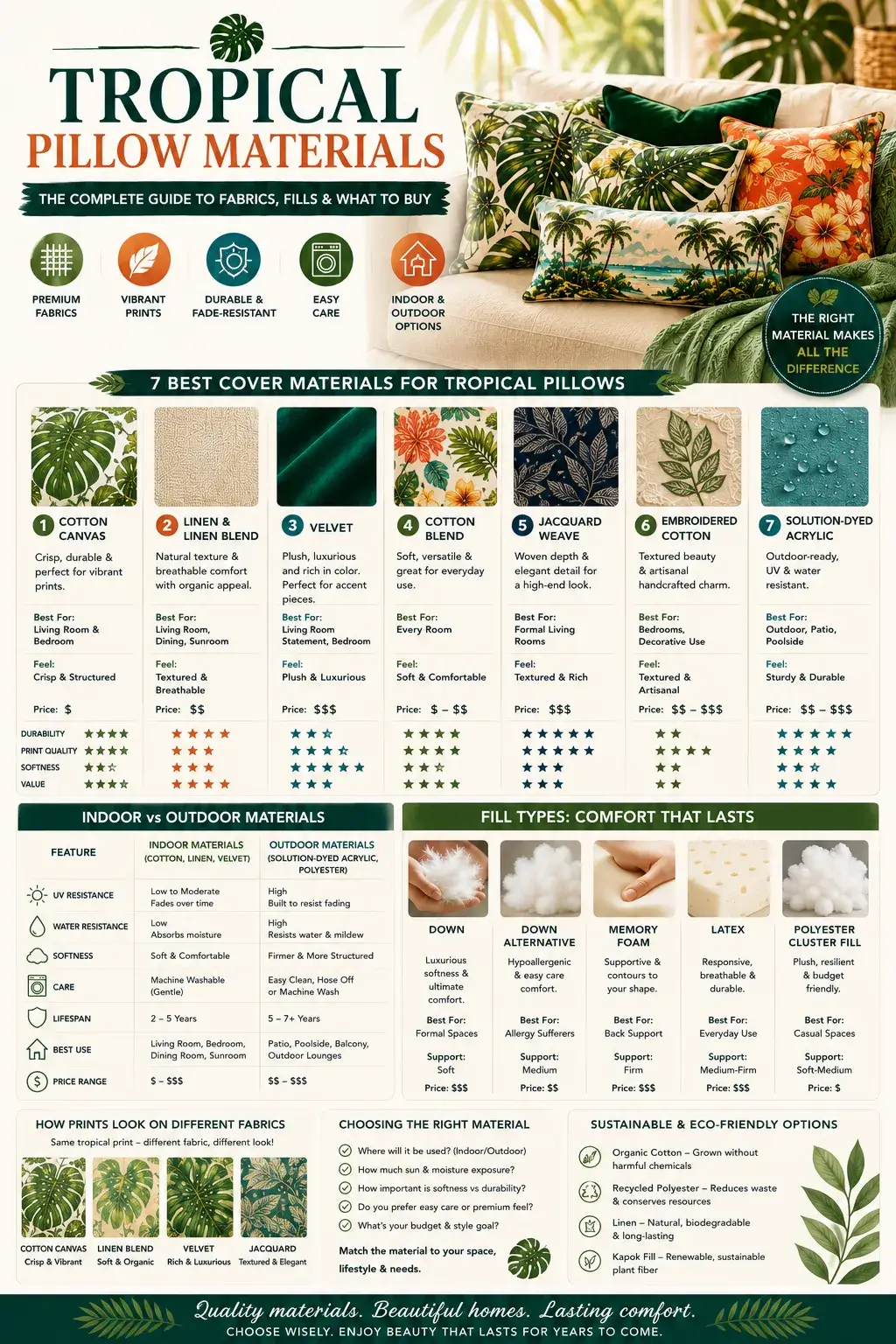
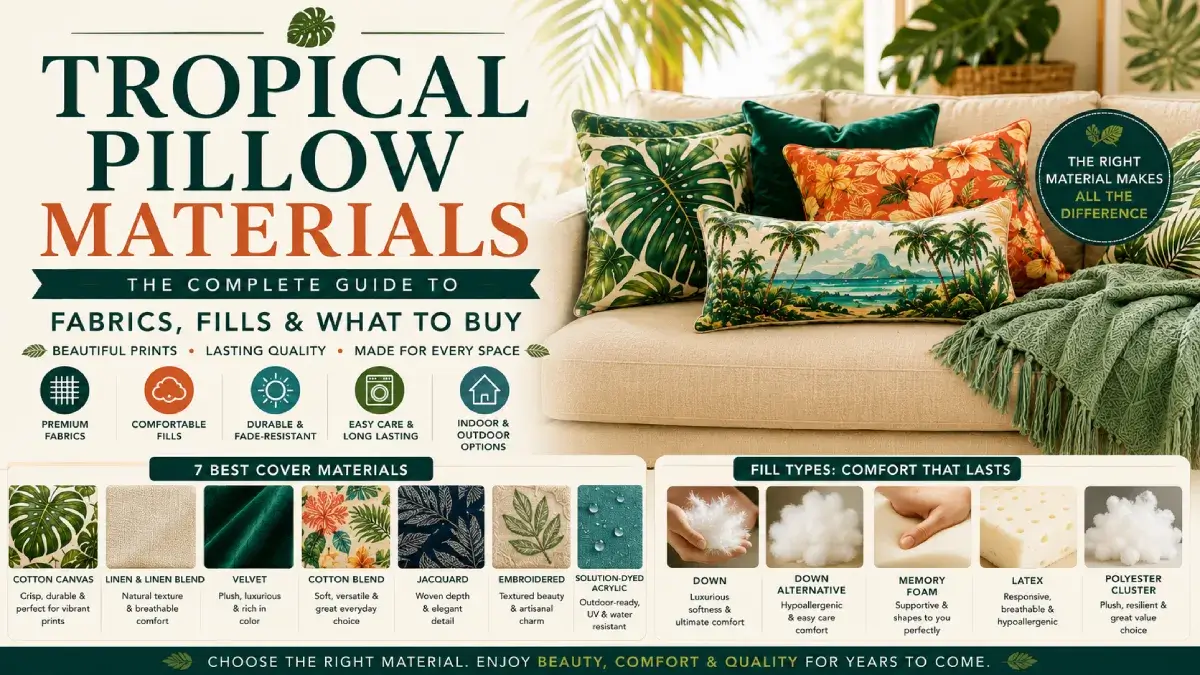
The 7 Best Cover Materials for Tropical Pillows
Cotton Canvas
Cotton canvas is the workhorse of tropical pillow covers — and for good reason. Its tight, even weave holds printed colors with exceptional sharpness. Botanical prints, palm fronds, and monstera leaves all render with crisp edges rather than bleeding into the fabric texture. This makes cotton canvas the single best material for digitally printed tropical designs where fine detail matters.
It's breathable, easy to machine wash, and improves with repeated laundering. Medium weight makes it comfortable for year-round indoor use across every room. A well-made cotton canvas cover typically lasts three to five years of regular use before showing significant wear. Budget-friendly price points mean you can rotate seasonal prints without significant investment.
Durability -80% | Print Quality – 85% | Softness – 65% | Value – 90%
Verdict: The best all-around choice for living room tropical pillows. Ideal for high-detail designs like monstera leaves, hibiscus, and palm fronds. Start here if you're unsure.
Linen & Linen Blend
Linen's natural slub texture adds an organic depth that perfectly complements tropical botanicals. The slight irregularity in the weave echoes the imperfection of natural foliage — creating a lived-in, resort-hotel quality that cotton canvas can't replicate. Pure linen softens beautifully with age, developing a suppleness that makes older linen pillows more attractive than new ones.
Linen-cotton blends balance the aesthetic benefits of linen with improved durability and reduced wrinkling. They're the practical choice for households that love the linen look but need something more forgiving. Avoid pure linen in high-humidity outdoor settings — linen is not moisture-resistant and will develop mildew without proper care.
Durability – 75% | Print Quality – 75% | Softness – 70% | Value – 75%
Verdict: Best for resort-style, relaxed tropical aesthetics. Pairs beautifully with neutral palettes and subtle botanical prints. Choose linen when you want the pillow to feel as good as it looks.
Velvet
Crushed and standard velvet deliver a lush, tactile tropical look that no other fabric can match. Velvet's real strength in a tropical scheme isn't in its printed versions — it's in solid jewel tones that anchor a bold palette. An emerald green velvet pillow, a sapphire blue, a deep coral: these become the grounding elements that make neighboring botanical prints pop rather than compete.
Printed velvet exists and can be strikingly beautiful, but it requires careful sourcing and even more careful washing. Velvet is not suitable for outdoor use or high-traffic family spaces. It marks easily, retains pet hair, and needs professional cleaning or confident hand-washing to maintain its pile.
Durability – 55% | Print Quality – 70% | Softness – 95% | Value – 50%
Verdict: Best as one or two accent pillows in a curated tropical living room or bedroom. Not a workhorse — a statement maker. Limit velvet to low-traffic display positions.
Embroidered Cotton
Embroidered tropical pillows bring a handcrafted, heirloom quality to decor that printed covers simply cannot replicate. Thread-stitched palms, hibiscus blooms, and fauna create dimensional texture that catches light differently throughout the day — a pillow that looks subtly different at noon than it does at dusk. This quality elevation is immediately visible even to non-design-minded guests.
The trade-off is fragility. Embroidered covers require hand washing in cold water, careful drying away from direct heat, and gentle handling to protect thread integrity. They're best positioned in lower-traffic display roles — the center pillow on a made bed, the single accent in a formal sitting area — where they're admired more than moved.
Durability – 60% | Print Quality – 95% | Softness – 65% | Value – 55%
Verdict: Best as the single featured display pillow in an arrangement. One embroidered piece elevates everything around it. Don't use embroidered covers where they'll be constantly handled.
Jacquard Woven
Jacquard weaves the tropical pattern directly into the fabric structure rather than printing onto the surface — the design is literally part of the textile. This fundamental difference in construction means the color cannot fade from washing because there is no surface dye to remove. A jacquard pillow looks essentially the same after one hundred washes as it did on day one.
Jacquard fabric is heavier and more structured than printed covers, lending a formal, resort-luxe quality to any space. It suits elevated tropical settings — think hotel lobby aesthetic, resort suite, or high-end dining room — rather than casual family living. The higher upfront cost is amortized over a much longer lifespan, making it genuinely good long-term value.
Durability – 90% | Print Quality – 90% | Softness – 60% | Value – 55%
Verdict: The long-term investment. If you want a tropical pillow that looks identical in ten years, choose jacquard. Best for formal or resort-luxe tropical settings.
Performance Polyester (Indoor)
Modern performance polyester has shed its budget-fabric reputation. Solution-dyed versions — where the color is embedded in the fiber rather than printed on the surface — resist staining, fading, and pilling while maintaining vibrant tropical prints through dozens of machine washes. If you have children, pets, or a genuinely busy household, this is the material that will save you the most frustration.
The trade-off is a slightly synthetic feel that natural-fiber enthusiasts will notice. It doesn't have the warmth of cotton or the texture of linen. But for a pillow that needs to survive real daily life — spills, sunscreen, pet hair, constant repositioning — performance polyester is the practical hero that premium fabrics simply cannot be.
Durability – 90% | Print Quality – 80% | Softness – 65% | Value – 95%
Verdict: The best practical choice for busy households. Not the most luxurious feel, but unmatched durability per dollar for high-traffic tropical decor.
Solution-Dyed Acrylic (Outdoor / Sunbrella-Grade)
Solution-dyed acrylic is the gold standard for outdoor tropical pillows — and for good reason. The color is locked into the fiber during the manufacturing process rather than applied to the surface afterward. This makes it colorfast to more than 2,000 hours of direct sun exposure. Competing outdoor fabrics begin fading within one season; quality solution-dyed acrylic looks the same after three years on a sun-drenched patio.
Beyond UV resistance, solution-dyed acrylic resists mold, mildew, and moisture absorption — critical properties for outdoor cushions exposed to morning dew, rain, and poolside splashing. Sunbrella is the most recognized brand; comparable alternatives from manufacturers like Outdura, Phifertex, and Glen Raven exist at various price points. For permanent outdoor seating, there is no practical substitute.
Durability – 98% | Print Quality – 80% | Softness – 50% | Value – 70%
Verdict: The only non-negotiable choice for permanent outdoor tropical pillows. Every other outdoor fabric is a compromise. The higher cost pays for itself within two seasons.
Indoor vs. Outdoor: Quick Material Comparison
The table below summarizes suitability, care requirements, and expected lifespan for all seven cover materials. Use this as a quick reference when comparing options before purchasing.
| Material | Indoor Use | Outdoor Use | UV Resistance | Wash Method | Price Range | Est. Lifespan |
|---|---|---|---|---|---|---|
| Cotton Canvas | Excellent | Not Suitable | Low | Machine wash cold | $8–$20 | 3–5 years |
| Linen Blend | Excellent | Not Suitable | Low | Gentle machine / hand wash | $18–$45 | 3–6 years |
| Velvet | Excellent | Never | Very Low | Hand wash / dry clean | $25–$80 | 3–7 years |
| Embroidered Cotton | Excellent | Never | Very Low | Hand wash only | $30–$90 | 4–8 years (display) |
| Jacquard Woven | Excellent | Limited | Moderate | Spot clean / dry clean | $40–$120 | 7–12 years |
| Performance Polyester | Excellent | Short-Term | Moderate | Machine wash warm | $8–$25 | 2–4 years |
| Solution-Dyed Acrylic | Good | Excellent | Very High | Spot clean, mild soap | $35–$120 | 5–10 years outdoor |
Bottom Line on Materials
For outdoor tropical pillows, solution-dyed acrylic is non-negotiable. For indoor use, cotton canvas or linen blend delivers the best balance of print quality, softness, and washability for most households. Velvet, embroidered cotton, and jacquard are reserved for display-position accent pieces.
Tropical Pillow Fill Types: The Complete Guide
The cover fabric gets all the visual attention, but the fill determines how the pillow actually looks — whether it's plump and luxurious or flat and sad. The right fill also affects how long the pillow holds its shape, how it can be washed, and whether it's safe for allergy sufferers. Here are the five main fill types used in tropical throw pillows.
Fill Type 1: Down & Feather
The trusted workhouse fabric of tropical pillow covers. Highly affordable, widely available, and accepts digital printing exceptionally well for razor-sharp botanical detail. Fully machine-washable. Has a slight tendency to wrinkle, which can actually enhance the casual, lived-in quality of Bohemian and Coastal Tropical styles. Best for: all-purpose indoor tropical pillows, casual living rooms, and relaxed bedrooms.
Pros:
Softest feel, shapeable, exceptionally long-lasting with care.
Cons:
Allergenic for some, quills can occasionally poke through thin covers, requires hand washing or careful machine washing, higher cost.
Best For:
Living room focal pillows, bedroom Euro shams, any display-position pillow where the look matters most.
Fill Type 2: Down Alternative (Polyester Fiberfill)
The most popular fill for everyday tropical throw pillows. Modern microfiber polyester fills rival down in softness at a fraction of the cost. They're hypoallergenic, machine washable, and available at every price point. The quality range is enormous — cheap fills go flat within one to two years, while high-fill-weight options (look for 20 oz or more) hold their loft through dozens of washes.
Pros:
Affordable, hypoallergenic, machine washable, widely available in all sizes.
Cons:
Cheaper versions compress quickly; can bunch and shift over time; doesn't give as clean a “karate chop” as down.
Best For:
Everyday tropical pillows, households with allergies, outdoor covers, seasonal rotation pieces.
Fill Type 3: Memory Foam
Memory foam provides firm, consistent support — ideal for lumbar pillows or accent pieces that double as actual seating support. It holds its shape perfectly without any fluffing and never shifts or bunches. The trade-off is that it cannot be submerged in water (spot clean only), it doesn't compress into a chop crease, and it's significantly heavier than fiber fills.
Pros:
Excellent support, holds shape permanently, zero maintenance fluffing required.
Cons:
Heavy, spot clean only, not suitable for decorative display positions, not for outdoor use.
Best For:
Lumbar support pillows on sofas, deep-seat patio chair cushions, reading nook back support.
Fill Type 4: Latex Foam
Natural latex is hypoallergenic and naturally antimicrobial — making it particularly well-suited to humid tropical environments where dust mites and mold are a concern. It provides consistent medium-firm support similar to memory foam but with slightly more bounce. Natural latex is one of the more sustainable fill options and biodegrades at end of life. Spot clean only — never submerge latex in water.
Pros:
Hypoallergenic, antimicrobial, good for humid rooms, eco-friendly, consistent support.
Cons:
Heavy, expensive, spot clean only, limited availability in smaller pillow sizes.
Best For:
Bedroom pillows, humid coastal climates, allergy-sensitive households prioritizing natural materials.
Fill Type 5: Polyester Cluster Fill
Hollow cluster fibers mimic down's loft and bounce at a more accessible price point than quality loose fiberfill. The cluster construction allows air to circulate between fibers, giving the fill better loft retention than standard polyfill. Machine washable and widely available in mid-range tropical throw pillows. The best budget-friendly down alternative for buyers who want a slightly more premium feel without the down price.
Pros:
Good loft retention, machine washable, more affordable than down, better structure than standard polyfill.
Cons:
Not as soft as genuine down, will compress somewhat over time.
Best For:
Mid-range tropical pillows, any situation requiring frequent laundering, everyday living room use.
Designer Recommendation
Use a down insert one size larger than the cover. A 20″×20″ down insert inside an 18″×18″ cover creates that hotel-plump, perfectly rounded look that polyester fills can never fully replicate. The extra fill forces the cover to hold its square shape and gives edges a satisfyingly structured appearance. This single trick elevates even budget pillow covers into something that looks genuinely designed.
How to Choose the Right Material for Your Tropical Pillows
The right material depends on four factors: where the pillow will live, how much use it will receive, whether allergies are a concern, and how much care you're willing to give it. Use the decision formulas and selector below to identify your best match.
High-Traffic Living Room
Cover: Performance polyester or cotton canvas
Fill: Polyester cluster fill (20 oz+)
Care: Machine washable covers essential
Budget: $18–$45 per pillow
Resort-Style Bedroom
Cover: Linen blend or velvet
Fill: Down or quality down alternative
Care: Hand wash covers quarterly
Budget: $50–$100 per pillow
Outdoor Patio / Poolside
Cover: Solution-dyed acrylic only
Fill: Quick-dry polyester fiberfill
Care: Spot clean; store end of season
Budget: $40–$100 per pillow
Small-Space Statement Piece
Cover: Jacquard woven or embroidered cotton
Fill: Down insert (one size up)
Care: Spot clean or professional clean
Budget: $80–$160 per pillow
1. Where will the pillow live?
Indoor only → any cover material works. Outdoor full-time → solution-dyed acrylic exclusively. Both indoor and outdoor → solution-dyed acrylic or performance polyester.
2. How much use will this spot get?
Display only (rarely touched) → velvet, embroidered, or jacquard. Daily use → cotton canvas or performance polyester. Heavy use (children, pets) → performance polyester with machine-washable fill.
3. Do you or family members have allergies?
Yes → choose down alternative polyester or natural latex fill. No → any fill type is appropriate; down gives the best look and longevity.
4. What is your care preference?
Machine wash only → cotton canvas or performance polyester cover + polyester fill. Hand wash acceptable → linen blend or velvet. Spot clean only → jacquard or acrylic cover + foam fill.
How Fabric Texture Affects Tropical Print Appearance
The same tropical print looks meaningfully different depending on the fabric it's applied to. This is one of the most underappreciated aspects of pillow shopping — and one of the most controllable ways to customize the aesthetic of a space without changing the design itself.
Cotton Canvas + Digital Print
Produces the sharpest, most photographic print edges. Ideal for highly detailed tropical designs — complex monstera leaf veining, layered palm fronds with visible texture, and fine hibiscus petal gradients all render with maximum clarity. If the design has intricate detail, cotton canvas is the only fabric that does it full justice.
Linen Blend + Screen Print
The slight natural slub of linen softens print edges into an organic, slightly painterly quality. Works beautifully for abstract or impressionistic tropical prints — bold color-block botanicals, oversized single-leaf designs, and loose tropical florals. The softening effect makes prints look more artisanal and less commercial.
Velvet + Solid Color
No print required — the color itself is the design element. Velvet's pile catches light directionally, making solid jewel-tone tropical colors (emerald, teal, coral, cobalt) appear to glow. Best used as an anchor or grounding pillow within a printed tropical arrangement, providing visual rest between bold patterns.
Jacquard Woven
Tonal depth comes from the weave structure itself rather than surface color. Jacquard is exceptional for repeat geometric tropical patterns — woven palm fronds, batik-style tropical motifs, and tonal banana leaf designs. The pattern appears subtler and more sophisticated than a printed version of the same design.
Embroidered Cotton
Creates a three-dimensional, sculptural effect that no flat-print fabric can match. Best applied to single focal-point tropical designs — a solitary hibiscus bloom, an elaborate parrot, a single oversized palm leaf. The dimensional quality is most effective when the design is simple and the craftsmanship is the feature.
Sustainable and Eco-Friendly Tropical Pillow Materials
Consumer demand for sustainable home textiles is growing rapidly, and tropical pillow materials are no exception. Several excellent sustainable options now perform on par with conventional materials.
Organic Cotton (GOTS Certified)
Grown without synthetic pesticides or fertilizers and certified by the Global Organic Textile Standard. Performs identically to conventional cotton canvas — same print quality, same washability, same durability — without the chemical inputs. Look for the GOTS label on the product listing or tag.
Recycled Polyester (rPET)
Manufactured from post-consumer plastic bottles. Has a substantially lower carbon footprint than virgin polyester with near-identical performance characteristics. Increasingly common in mid-range tropical throw pillows and outdoor covers. Essentially indistinguishable from virgin performance polyester in day-to-day use.
Linen
Naturally one of the most sustainable textiles available. Flax (the source plant) requires significantly less water than cotton and grows without pesticides in many regions. Linen is fully biodegradable at end of life. Its environmental credentials are inherent — no certification required to confirm low impact.
Kapok Fill
A natural, plant-based fill harvested from kapok tree seed pods — soft, lightweight, hypoallergenic, and fully biodegradable. A genuinely sustainable alternative to both down and polyester fill. Less widely available than conventional fills but increasingly stocked by specialty home goods retailers.
Certification Tip
Look for GOTS (Global Organic Textile Standard) or OEKO-TEX Standard 100 certification on tropical pillow listings. GOTS confirms organic fiber sourcing and processing. OEKO-TEX certifies that no harmful chemicals are present in the finished product — covering both the fabric and any dyes or finishing treatments used in manufacturing.
Price vs. Quality: Where to Spend on Tropical Pillow Materials
A common pillow purchasing mistake is allocating the same budget to covers and inserts. The insert determines the look — a cheap insert in an expensive cover produces a flat, disappointing result. The cover is swappable; the insert is the foundation. Prioritize fill quality over cover cost if you have to choose.
| Budget Tier | Cover Material | Cover Cost | Fill Type | Fill Cost | Total | Expected Lifespan |
|---|---|---|---|---|---|---|
| Budget | Performance poly or cotton canvas | $8–$15 | Standard polyester fiberfill | $10–$20 | $18–$35 | 1–3 years |
| Mid-Range | Cotton canvas or linen blend | $20–$45 | Polyester cluster fill | $25–$40 | $45–$85 | 3–5 years |
| Premium | Jacquard / Embroidered / Velvet | $50–$120 | Down or quality down alternative | $40–$80 | $90–$200 | 5–10 years |
| Outdoor | Solution-dyed acrylic | $35–$100 | Quick-dry polyester | $15–$30 | $50–$130 | 4–8 years outdoor |
Pro Tip:
Buy one premium jacquard or embroidered pillow per seating arrangement and surround it with mid-range cotton canvas covers. The single quality piece elevates everything around it. Guests notice the one exceptional pillow — not the five that support it.
Frequently Asked Questions
What is the best fabric for tropical throw pillow covers?
Cotton canvas is the best all-around fabric for tropical throw pillow covers, offering sharp print quality, easy machine washing, and solid durability at an accessible price. For outdoor use, solution-dyed acrylic (Sunbrella-grade) is the definitive choice for UV and moisture resistance. For luxury indoor settings, linen blend delivers a beautiful resort aesthetic, while velvet adds maximum softness and visual richness as an accent piece.
What fill is best for tropical throw pillows?
A quality down insert gives tropical throw pillows the plump, shapeable appearance that designers prefer — especially when using one size up from the cover dimensions. For budget or high-use situations, a high-fill-weight polyester cluster fill (20 oz or more) is the best alternative. For outdoor tropical pillows, always use quick-dry polyester fiberfill — down, memory foam, and latex should never go inside outdoor covers.
Are tropical pillow covers machine washable?
It depends entirely on the material. Cotton canvas and performance polyester covers are generally safe to machine wash on a cold, gentle cycle in a mesh laundry bag. Linen blends can typically handle a gentle machine cycle but are safer hand-washed. Velvet, embroidered cotton, and jacquard woven covers should always be hand washed in cold water or taken to a professional dry cleaner. Check the care label before the first wash — it overrides all general guidance.
What material should I choose for outdoor tropical pillows?
Solution-dyed acrylic (Sunbrella and equivalent brands) is the only material specifically engineered for permanent outdoor pillow use. Its color is locked into the fiber during manufacturing, making it colorfast to 2,000+ hours of direct sun exposure. It also resists mold, mildew, and moisture. Performance polyester is a budget alternative that works adequately for covered patios and occasional outdoor use, but will fade noticeably faster under direct sun.
Is linen or cotton better for tropical pillow covers?
Both are excellent choices for indoor tropical pillows — the decision comes down to aesthetic priority. Cotton canvas delivers sharper print detail and slightly better durability, making it the better choice for intricate botanical designs. Linen blend creates a softer, more textured, organic look that improves with age — best for relaxed resort-style aesthetics and simple tropical prints. When in doubt: cotton canvas for maximum print clarity, linen blend for maximum character and texture.
Choosing the Right Tropical Pillow Material
Material is the single most important purchasing decision in tropical pillow shopping — more important than brand, more important than price, and arguably more important than print design. The right fabric makes a $25 pillow look like a considered design choice. The wrong one makes a $100 pillow look like a mistake within a season.
For indoor use, cotton canvas covers most needs with the best combination of print quality, washability, and value. Linen blend elevates the aesthetic for resort-style spaces. Velvet, embroidered cotton, and jacquard are the accent and investment options. For outdoor use, solution-dyed acrylic is the only serious choice. For fills, down gives the best look; quality polyester cluster fill is the practical everyday alternative.
The perfect tropical pillow isn't defined by its print alone. The right combination of fabric and fill determines how it looks, feels, performs, and lasts. By matching the material to your room, lifestyle, and maintenance preferences, you can create tropical spaces that remain beautiful for years instead of seasons.
Ready to shop? Explore our full range of tropical throw pillows in cotton canvas, linen, and solution-dyed acrylic — with inserts available separately so you can build the exact combination that suits your space. Not sure about your budget? Read our Budget vs. Premium Pillow Guide before you buy.