Walk into any home goods store, browse an online boutique, or scroll through an interior design catalog, and the price range for throw pillows is utterly bewildering. A decorative pillow cover can cost $6 at one end of the aisle and easily soar to $180 at the other. Conceptually, both are simply rectangles of fabric stuffed with fill. So what is the discerning buyer actually paying for at the premium end — and is any of it truly worth the investment?
The answer is highly nuanced and depends heavily on how the pillow will be used. Some premium features genuinely matter: superior fabric quality, robust color fastness, and insert fill type will absolutely determine how long the pillow lasts and how it physically supports you. Other elements are purely brand premium, offering little to no tangible improvement to the home decorator. Meanwhile, some budget options are genuinely excellent for their specific, targeted use cases.
This comprehensive guide cuts through the marketing confusion with a complete, category-by-category comparison of budget, mid-range, and premium throw pillows. We will cover covers, inserts, specialized outdoor fabrics, and how the print quality of tropical patterns shifts drastically across price points. By the end of this guide, you will know exactly where to spend and where to strategically save for your specific decorating situation.
| Situation | Best Choice |
|---|---|
| Guest Bedroom | Budget |
| Main Sofa | Mid-Range |
| Luxury Statement Piece | Premium |
| Outdoor Patio | Premium |
| Seasonal Decor | Budget |
The Three Price Tiers: What They Actually Mean
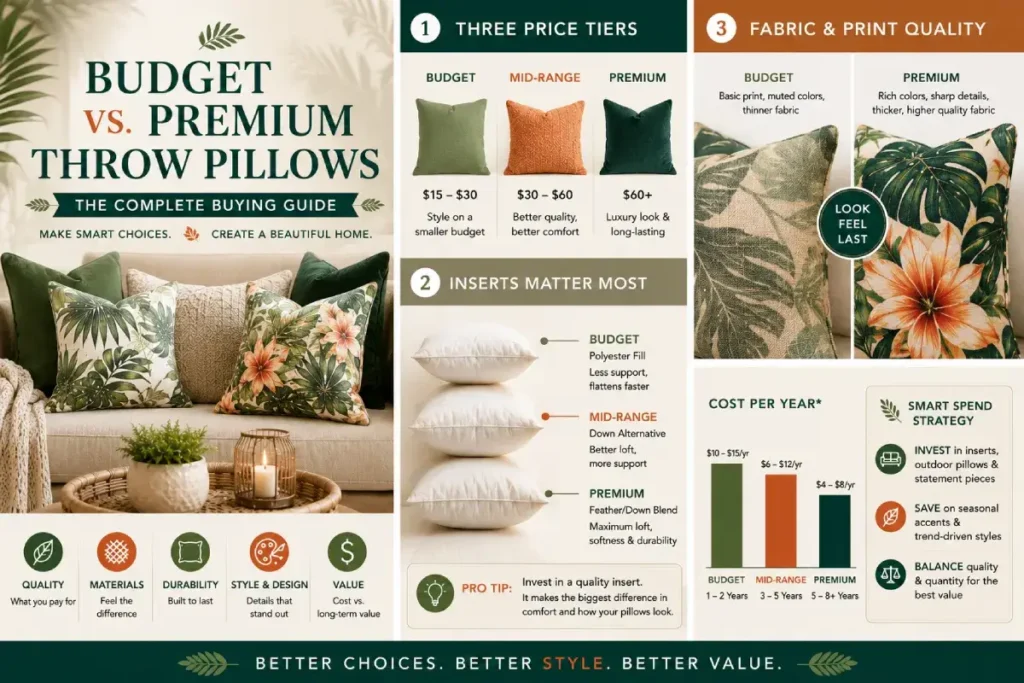
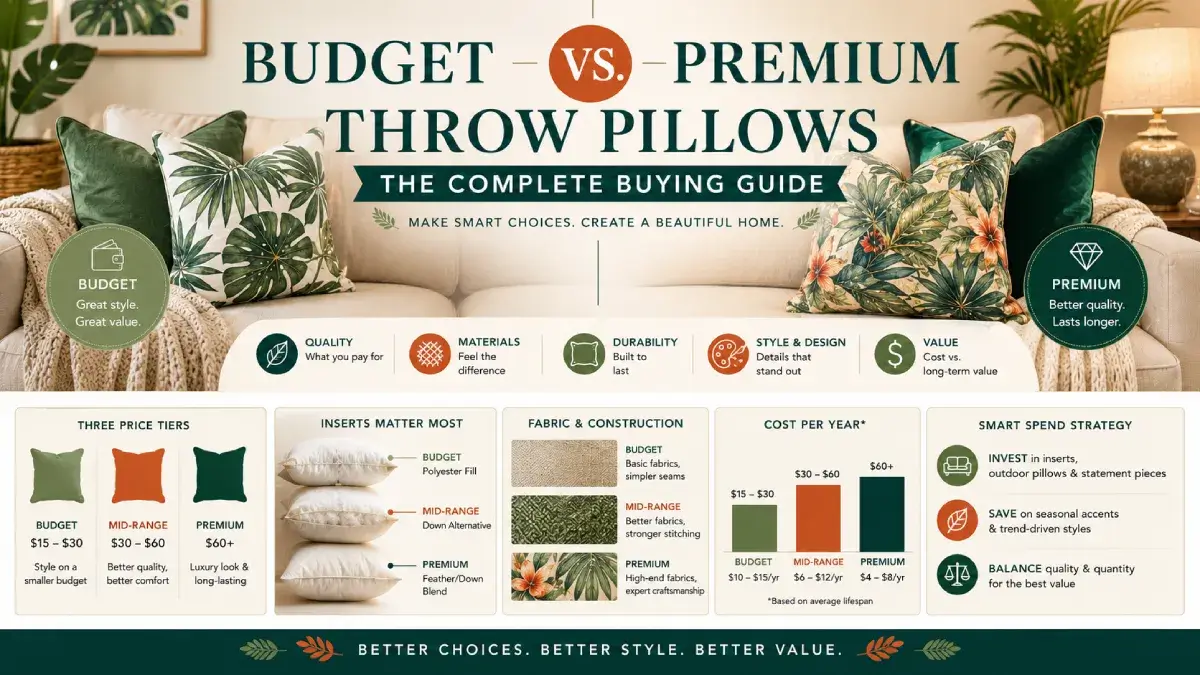
To evaluate whether a pillow is worth its asking price, we must first establish the common industry price tiers. These ranges apply strictly to the pillow cover itself, assuming the insert is sold separately (which is the gold standard for quality purchasing):
- Budget: $6–$18 per cover
- Mid-Range: $20–$55 per cover
- Premium: $60–$180+ per cover
It is critical to clarify that “premium” is not universally better for every single use case. A $12 budget cover placed in a guest bedroom that sees use three times a year is a significantly smarter purchase than a $90 premium cover in the exact same application. Context — frequency of physical use, exposure to direct sunlight, the presence of children or pets, and indoor versus outdoor environments — ultimately determines the right tier for your needs.
The Right Question
Don't ask ‘Is premium worth it?' Ask ‘What is this pillow's job?' High-use, UV-exposed, or frequently washed pillows deserve a higher tier investment. Low-traffic guest rooms, seasonal display pillows, and ‘style-test' purchases are ideal budget territory.
Covers: What You Actually Get at Each Price Point
The visual impact of your throw pillow relies entirely on the cover. Fabric weight, printing methodology, and construction details shift dramatically as you move up the pricing tiers. Here is exactly what you can expect when paying for a cover in each category.
Budget Pillow Covers
Price range: $6–$18 per cover
- Predominantly polyester or poly-cotton blends (often 65/35 or 80/20 ratios).
- Surface-printed designs where the ink sits physically on top of the fabric rather than being woven in or chemically bonded.
- Zipper closures are often thin plastic, may easily catch on inner threads, and frequently fail after multiple wash cycles.
- Thread count typically hovers around 180–250; the fabric generally feels noticeably thin to the touch.
- Colors may visibly fade after just 3–5 machine wash cycles, which is especially noticeable on bold tropical prints featuring bright greens and corals.
- Adequate for: low-traffic rooms, short-term seasonal displays, children's rooms (where rapid replacement is expected anyway), and style-testing before fully committing to a new color direction.
Best For
Style testing, guest bedrooms, kids' rooms, and fleeting seasonal trends you may not keep long-term. Expect to replace these every 1–2 years or as soon as fading becomes visibly distracting.
Mid-Range Pillow Covers
Price range: $20–$55 per cover
- Constructed from pure cotton, linen, linen-cotton blends, or high-quality synthetic velvet.
- Better print methods: screen-printed or digitally printed with reactive dyes that chemically bond to the fiber, making them significantly more washfast.
- Zipper quality improves notably; YKK or equivalent heavy-duty concealed zippers are common.
- Thread count generally sits between 250–400; the fabric boasts a satisfying weight, structural integrity, and proper drape.
- Embroidery, tufting, and tassel details introduced at this tier are quality-finished and will not easily unravel.
- Colors will successfully hold through 20–30+ wash cycles provided proper care instructions are followed.
- Lifespan: 3–5 years with regular, daily use and proper washing routines.
- Adequate for: the primary living room sofa, master bedroom, and frequently used seating areas.
Best For
Primary living spaces, daily-use sofas, and anyone who wants genuine quality without luxury pricing. This tier represents the absolute sweet spot for most TropicalPillow.com shoppers seeking durability and beautiful aesthetics.
Premium Pillow Covers
Price range: $60–$180+ per cover
- Fabricated from pure heavyweight linen, dense cotton velvet, intricate jacquard weave, or advanced performance fabrics.
- Woven-in or elaborately embroidered designs (not surface-printed) — patterns that literally cannot fade because they are structurally part of the fabric itself.
- Truly invisible or expertly concealed zippers; some high-end options use envelope closures or button closures featuring fabric-covered buttons.
- Thread count frequently exceeds 400; the fabric provides genuine tactile luxury — unmistakable weight, rich texture, and intense visual depth.
- Hand-finished bespoke details: French seams, piped edges, hand-stitched embroidery, and the use of natural, artisanal dyes.
- Colors are virtually permanent — a premium quality linen cover should effortlessly outlast 5+ years of regular, heavy use with only the most minimal, natural fading.
- Lifespan: 5–10 years with proper care and maintenance.
Best For
Resort Luxe and Dark Tropics styling, high-traffic primary sofas, bold statement pieces where quality is immediately visible, and anyone intentionally building a long-term, heirloom pillow collection. Cost-per-year analysis often favors premium.
| Feature | Budget | Mid-Range | Premium |
|---|---|---|---|
| Fabric Quality | Basic | Good | Excellent |
| Color Retention | Fair | Very Good | Outstanding |
| Lifespan | 1–2 Years | 3–5 Years | 5–10 Years |
| Best Use | Seasonal | Daily Use | Investment Piece |
Inserts: Where Budget vs. Premium Matters Most
While the cover dictates what your pillow looks like, the insert dictates entirely how your pillow feels, how it supports you, and whether your arrangement looks lush and designer-styled or flat and sad. In many interior design circles, professionals argue that the insert tier matters significantly more than the cover tier for the physical experience of the pillow.
Budget Inserts ($5–$12)
These are typically filled with basic polyester fiber fill or hollow-fiber synthetic materials. They offer adequate initial loft right out of the package but carry a massive clumping risk. Within 6–18 months, these fibers mat together, creating lumpy areas and hollow voids. They are perfectly acceptable for accent pillows used primarily for visual effect rather than physical support (e.g., decorative bed pillows that are removed every night before sleeping). Realistic lifespan: 1–2 years of daily use.
Mid-Range Inserts ($15–$30)
This tier introduces down-alternative cluster fill or high-quality micro-denier microfiber. These advanced synthetics mimic the structure of down clusters, providing far better loft retention and significantly less clumping, and they are fully machine washable. This is the realistic, practical choice for most people. Inserts in this range (from reliable brands like Parachute, Coop Home Goods, or even the IKEA FJÄDRAR) provide hotel-quality plumpness at highly accessible prices. Realistic lifespan: 3–5 years.
Premium Inserts ($35–$80+)
At the top tier, you find authentic European white goose down or certified RDS (Responsible Down Standard) duck down blends. These inserts offer exceptional loft retention, feel luxuriously soft against the back, and recover fully and immediately after heavy compression. Some high-end down inserts can last 10+ years with regular fluffing. Furthermore, the coveted “karate-chop” indent that makes pillows look magazine-ready is almost exclusively achievable with quality down or high-end down-alternative fill. Realistic lifespan: 5–10 years.
The Smart Spend Hierarchy
Invest more in your INSERT than your COVER. A $40 down-alternative insert placed inside a $25 cover will look, feel, and function dramatically better than a $65 premium cover stuffed with an $8 poly-fill insert. The insert determines the physical experience and the structural shape; the cover provides the visual style. If you must compromise, budget the cover and invest in the insert.
Outdoor Pillows: Where Premium Almost Always Wins
If there is one specific category where the premium tier is nearly always the better financial decision—even for the most budget-conscious buyers—it is outdoor throw pillows. The harsh realities of nature make budget outdoor pillows a terrible long-term investment.
Here is exactly why outdoor pillow economics favor the premium tier:
- Budget outdoor pillows ($8–$20): These utilize basic surface-dyed polyester with a light, temporary DWR (Durable Water Repellent) spray. UV resistance is minimal, meaning bright colors will fade dramatically within a single summer season. The basic poly fill becomes easily waterlogged and will rapidly grow mold after rain exposure. Realistic lifespan: 1–2 seasons.
- Mid-range outdoor ($25–$60): These feature solution-dyed polyester with robust, factory-applied DWR coating. They offer a respectable 2–3 season lifespan and are entirely adequate for covered patios, shaded balconies, and screened-in lanais where direct sun is mitigated.
- Premium outdoor ($65–$150): Built using Sunbrella (solution-dyed acrylic) or marine-grade fabrics. The color is not printed on the surface; it goes to the very core of the fiber like a carrot, rather than a radish. They offer a 5–7 season lifespan, are entirely bleach-cleanable, highly mold-resistant, and UV-guaranteed (many carry strict 5-year fade warranties).
Consider the basic cost-per-season analysis: Buying a budget pillow at $12 and replacing it three times over three years equals $36. Buying a premium Sunbrella pillow at $85 and using it for 5 or more seasons equals roughly $17 per season. Premium is significantly cheaper long-term.
The Outdoor Premium Rule
For any pillow that will face direct sunlight, heavy rain, or constant high humidity, calculate your cost-per-season rather than cost-per-purchase. A single Sunbrella cover bought once almost always beats three budget covers bought repeatedly. Solution-dyed fibers are the single most important quality indicator for outdoor pillows.
Tropical Prints: Budget vs. Premium Print Quality
For fans of tropical decor, the way bold botanical patterns are rendered onto fabric is a massive differentiator. Complex tropical designs—featuring varied shades of green palm fronds, the delicate veining of a monstera leaf, or the subtle gradient shading of hibiscus petals—reveal print quality immediately.
- Budget tropical prints: You will generally find solid-color backgrounds with basic screen-printed botanical motifs. Print registration can frequently be slightly off (resulting in blurry leaf edges where colors overlap). Colors may be incredibly vivid initially but will shift or dull significantly after washing. The fine, intricate detail (vein lines in leaves, realistic gradient shading in flower petals) is inevitably lost at this price point due to simplified printing mechanics.
- Mid-range tropical prints: This tier utilizes reactive-dye digital printing, which allows for breathtaking, photographic-quality botanical detail. Colors are deeply accurate, nuanced, and wash-stable. The visual difference in print quality and depth between a $15 and $35 tropical cover is very visible upon close inspection.
- Premium tropical prints: These covers are either woven jacquard (where the tropical pattern is structurally part of the interwoven fabric itself — meaning it physically cannot fade because there is no surface ink), hand-screen-printed with artisanal natural dyes (making each cover slightly unique), or digitally printed on premium heavyweight linen with specialist inks. Fine botanical detail is nothing short of extraordinary at this top tier.
The Close-Inspection Test
When evaluating a tropical print pillow cover online, zoom closely into the leaf edges and petal details. Crisp, clean edges with visible internal shading and smooth color gradients equate to a high-quality print process. Blurry, pixelated, or jagged edges at the border of distinct colored areas indicate a basic screen print that will look significantly worse after washing.
The Smart Spend Strategy
How do you practically apply all this information? The secret is a targeted “smart money” strategy based on specific usage scenarios. You do not need to buy all premium or all budget; you need to mix them effectively. Follow these formulas for optimal spending:
FORMULA CARD 1: High-Traffic Primary Sofa
Recommendation: Mid-range covers ($25–$50 each) + Mid to premium inserts ($25–$40 each)
Why: This sofa sees heavy daily use, frequent washing, and close inspection. Quality covers will hold their color through wash cycles; quality inserts will maintain proper loft under the weight of people leaning on them. Over 3–5 years, mid-range outperforms budget decisively in high-traffic zones.
FORMULA CARD 2: Guest Bedroom / Decorative Display
Recommendation: Budget to mid-range covers ($12–$28 each) + Budget inserts ($8–$15 each)
Why: Low wash frequency, minimal physical use, and minimal UV exposure mean that even budget covers can easily last 3–5 years in this environment. This is prime “style-test” territory where saving money makes total logical sense.
FORMULA CARD 3: Outdoor Patio / Pool Deck
Recommendation: Mid-range minimum ($35+), premium strongly recommended (Sunbrella $65–$120)
Why: Relentless sun, driving rain, and high humidity make budget covers a guaranteed annual, frustrating expense. Premium solution-dyed covers ultimately cost far less per season and result in vastly less maintenance frustration.
FORMULA CARD 4: Statement / Style Anchor Pillow
Recommendation: Premium cover ($65–$120) + Premium insert ($40–$65)
Why: One exceptional, luxurious pillow can entirely define a room's design direction. In a standard 5-pillow arrangement, investing your premium budget in the boldest 1–2 central pieces and utilizing mid-range covers for the supporting solid pillows is the most highly effective allocation of funds.
Red Flags When Buying Pillows at Any Price
There are certain warning signs you should look for regardless of the price tier. These indicators consistently signal poor quality manufacturing, and if you spot them on an expensive pillow, you are likely paying for pure brand markup rather than actual quality.
- No material composition label: Quality brands always proudly disclose their specific fabric content (e.g., 100% Linen, 80% Cotton / 20% Polyester). A missing tag is a massive red flag.
- “Handmade” with visible uneven stitching at seams: While handmade is lovely, highly inconsistent seam quality, puckering edges, or loose threads suggests rushed, careless manufacturing rather than artisanal craftsmanship.
- Visible misregistration on bold tropical prints: If the colors do not align precisely at the design edges (the green of a leaf bleeds out of the outline), it indicates a basic, low-budget screen printing process that is highly likely to fade and blur further.
- “Outdoor” label without specifying solution-dyed or UV-resistant: This is frequently just marketing language with no technical, weather-proof backing.
- No care instructions provided: Quality manufacturers care about longevity and will always provide clear, specific washing or dry-cleaning guidance.
- Covers sold exclusively as a matching “set” with no option to mix: This heavily limits your styling flexibility and usually signals a lower-quality, mass-produced product intended to fill big-box store shelves.
The Zipper Test
At any price point, physically test the zipper before buying in store, or immediately upon unboxing an online order. A quality zipper should glide smoothly without catching or snagging in one fluid pass. A zipper that requires two hands to pull, sticks midway, or skips teeth will almost certainly fail within months of regular use.
The Cost-Per-Year Calculation
To truly understand the value of your throw pillows, you must stop looking at the retail sticker price and start calculating the true cost-per-year of ownership. Evaluating durability changes the entire conversation around budget versus premium.
Formula: Cost-Per-Year = Purchase Price ÷ Expected Lifespan in Years
| Tier | Cover Price | Insert Price | Total Price | Expected Lifespan | True Cost/Year |
|---|---|---|---|---|---|
| Indoor Budget | $12 | $8 | $20 | 1.5 years | $13.33 / yr |
| Indoor Mid-Range | $35 | $22 | $57 | 4 years | $14.25 / yr |
| Indoor Premium | $85 | $50 | $135 | 8 years | $16.88 / yr |
| Outdoor Budget | $15 | $10 | $25 | 1 season | $25.00 / yr |
| Outdoor Premium (Sunbrella) | $95 | $20 | $115 | 6 seasons | $19.17 / yr |
The conclusion drawn directly from the mathematical reality is clear: at reasonable lifespans, indoor budget and mid-range pillows have a nearly identical cost-per-year. Therefore, the choice between them comes down entirely to the quality of your daily physical experience, not pure economics. However, for outdoor pillows, the premium tier wins clearly on both the luxury of the experience AND the long-term economics.
Frequently Asked Questions
Are expensive throw pillows actually worth it?
For primary, high-use sofas and highly exposed outdoor spaces: yes, they clearly are. For guest bedrooms and quick, seasonal style tests: no, budget-to-mid-range options serve the purpose equally well without wasting funds. The smart approach is heavily tiered: deliberately invest premium dollars in 1–2 central anchor pieces, utilize mid-range for your supporting foundational pillows, and stick to budget options strictly for seasonal or low-use contexts.
What is a reasonable amount to spend on throw pillows?
For a standard living room sofa set consisting of 5 pillows: $150–$250 total (including both covers and quality inserts) is the mid-range sweet spot providing excellent quality and long-term value. A truly high-quality, premium anchor arrangement for a luxury primary living room may run $300–$450. Outdoor sectional sets utilizing specialized Sunbrella covers typically run $400–$700 for a full, weather-proof set.
Why do designer throw pillows cost so incredibly much?
Premium pillows command significantly higher prices due directly to fabric quality (utilizing heavyweight pure linen or complex jacquard weaves), superior print methods (structurally woven or hand-screen-printed with organic dyes versus cheap digital surface prints), vastly better construction (incorporating French seams, concealed zippers, and hand-finished details), and often smaller, artisanal production runs that inherently cost much more per unit to manufacture than mass-produced big-box items.
Is it better to buy a pillow cover and the insert separately?
Almost always, yes. Buying your covers and your inserts entirely separately allows you to actively size the insert correctly (always purchasing an insert 2 inches larger than the measured cover), deliberately choose the best specific fill type for your physical use case, and logically replace components entirely independently when one wears out before the other, saving you money long-term.
What specific fill type is best for throw pillow inserts?
A high-quality down-alternative cluster fill is arguably the best overall choice for the vast majority of buyers: it boasts far better loft retention than cheap poly-fill, is significantly more affordable than real goose down, is easily machine washable, and is fully hypoallergenic. True European white goose down remains the undisputed premium choice for those demanding maximum luxury, perfect shaping, and the absolute longest lifespan.
Conclusion
The great budget versus premium throw pillow debate has absolutely no universal answer — but it does have a highly context-dependent answer. The secret to beautifully styling your home without wasting your budget is simply matching your price tier to your specific use case. Invest your premium dollars where it tangibly counts: highly exposed outdoor pillows, primary high-traffic living room sofas, and the one or two bold anchor pieces that actively define your room's entire design direction.
Conversely, happily save your budget money where daily physical use is light, washing is highly infrequent, and playful style experimentation is your primary goal. And in absolutely every case, spend proportionally more money on your insert than you initially think is necessary — the insert is what the pillow physically feels like and how it holds its shape. The cover is simply what it says. Both matter deeply, but they do not matter equally.
The smartest buyers rarely choose all budget or all premium. They build pillow collections strategically, investing where durability and daily comfort matter most while saving where style alone does the job.