
Have you ever looked at a beautifully styled room in a catalog and wondered exactly how they managed to make the throw pillows look so effortless and perfectly placed? Most styling guides will happily tell you what to do—mix patterns, use different sizes, add a lumbar—but they completely gloss over the practical, hands-on instructions of how to actually execute it. This guide is distinctly different.
Here, we will walk you through the complete pillow arrangement process step-by-step. From taking the initial measurements of your furniture to physically placing each pillow at the precise angle, this is your actionable blueprint. Whether you are starting with a completely blank sofa, seeking to refresh a tired bedroom setup, or upgrading an outdoor patio space, this process makes beautiful, designer-quality results entirely achievable. No interior design degree is required—just follow the steps.
| Layer | Purpose | Example Size |
|---|---|---|
| Foundation | Anchor | 22×22 |
| Character | Pattern | 20×20 |
| Accent | Contrast | Lumbar |
Before You Begin: What You Need
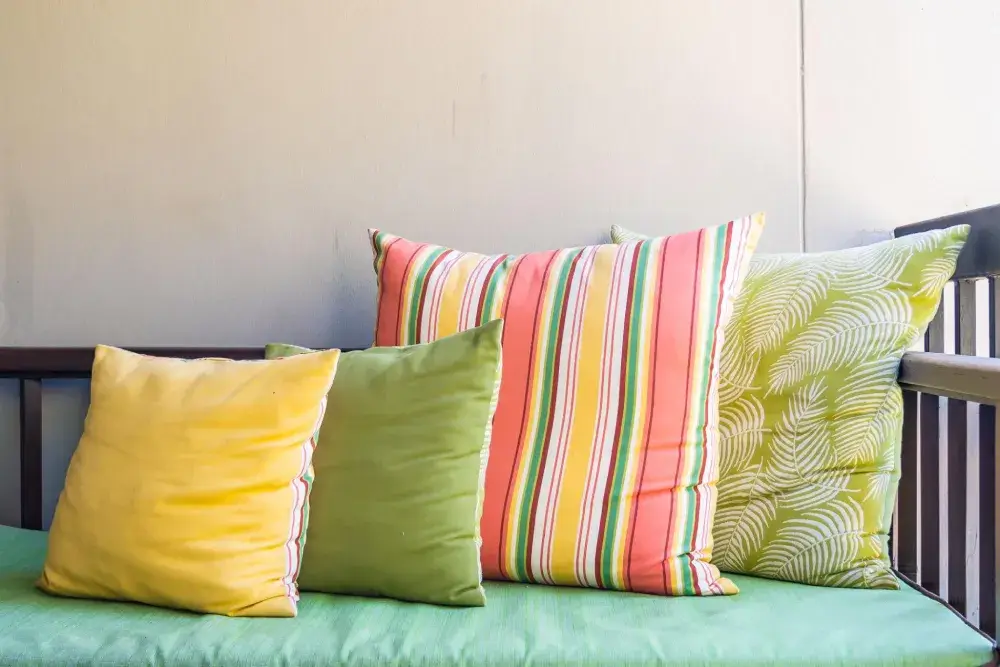
A successful pillow arrangement begins long before you touch a single fabric cover. Preparation is the key that prevents the common cycle of buying pillows, bringing them home, deciding they don't look right, and returning them. Before we begin the arrangement process, you need to firmly establish three pieces of baseline information.
First, you need to know your furniture dimensions. The width and depth of your sofa dictate exactly how many pillows you need and what size they should be. Second, you must assess your existing room colors to ensure your new pillows visually anchor to the space. Finally, determine your budget, as this will influence whether you buy a complete set or mix high-and-low sources.
PRE-ARRANGEMENT CHECKLIST
- ☑ A reliable tape measure
- ☑ Your phone camera (to photograph the room's dominant colors)
- ☑ A notepad and pen for recording dimensions
- ☑ A completely cleared furniture surface to start fresh
- ☑ Good natural lighting to accurately judge fabric tones
- ☑ Your current pillows (if any) stacked nearby for size comparison
Step 1 — Measure Your Furniture
1. Determine Your Foundation Sizes
This is the most important and most frequently skipped step. People buy pillows based on the pattern they love, ignoring the physical scale of the sofa they are placing it on. Width determines your pillow quantity. A standard sofa requires more pillows than a loveseat, and a sprawling sectional requires the most. Seat depth determines your minimum pillow size. If you place standard 18×18 pillows on a deep-seat luxury sofa, they will look tiny and insignificant.
For a standard sofa measuring 84–90 inches wide, you should base your arrangement with a 20×20 minimum, though 22×22 is ideal. If you own a deep-seat sofa with a depth of 36 inches or more, you must step up to a 24×24 anchor pillow. Conversely, a loveseat (60–72 inches) handles 18×18 pillows quite well, though 20×20 still provides a more plush, modern look. When dealing with a sectional, treat each main length (usually around 84 inches per side) independently.
| Sofa Width | Seat Depth | Recommended Pillow Size | Pillow Quantity |
|---|---|---|---|
| 60–72″ (Loveseat) | Standard (≤32″) | 18×18 – 20×20 | 3–4 pillows |
| 80–90″ (Standard) | Standard (≤32″) | 20×20 – 22×22 | 5 pillows |
| 80–90″ (Standard) | Deep (33–38″) | 22×22 – 24×24 | 5 pillows |
| 90″+ (Large) | Any Depth | 22×22 – 24×24 | 5–7 pillows |
| Sectional (per section) | Deep (36″+) | 22×22 – 24×24 | 5–8 per section |
Step 2 — Choose Your Color Anchor
2. Establish the Palette
Pillows cannot exist in a vacuum; they must relate directly to the room they inhabit. To identify your “anchor color”—the dominant shade the arrangement will be built around—start by photographing your room. Identify the single most dominant neutral already present, whether it's your sofa upholstery, the area rug, or the wall color. This will be the color of your largest foundation pillows.
Next, choose one accent color already established in the room (from artwork or curtains). Finally, choose a single “pop” color that is NOT heavily featured elsewhere; this unexpected shade injects energy and life into the composition. For tropical rooms, anchor in a deep navy or sandy neutral, use vibrant teal or palm green as a secondary color, and reserve bright coral or hibiscus yellow for the pop.
Use the Paint Chip Test
Take a physical paint chip or fabric swatch matching your room's dominant color with you to the store, or hold it up to your screen while shopping online. Place it next to potential pillow covers. Colors that appear to naturally “pop” and harmonize with your swatch are your safest, most striking picks.
Learn more in our tropical color palette guide.
Step 3 — Build Your Shopping List
3. Map Out the Purchases
Now that you know your sizes and colors, you must build a highly specific shopping list. A standard sofa arrangement consists of five pillows. Item 1: Two large solid pillows (e.g., 22×22) in your dominant anchor color. Item 2: Two medium printed pillows (e.g., 20×20) featuring a bold pattern that contains BOTH your secondary color and your pop color. Item 3: One lumbar pillow (12×20 or 14×22) showcasing your pop color in a fun, contrasting texture.
Crucially, you must remember the golden rule of pillow shopping: always buy inserts 2 inches LARGER than your covers. If you purchase an 18×18 cover, you must buy a 20×20 insert to ensure it looks beautifully stuffed rather than sad and deflated.
SHOPPING LIST TEMPLATE
- Foundation pillow color: ____________ | Size: ______ | Quantity: 2
- Character pillow pattern: ____________ | Size: ______ | Quantity: 2
- Accent lumbar color: ____________ | Size: ______ | Quantity: 1
- Insert size for each cover (cover size + 2 inches): ____________
Pair covers correctly using our best pillow inserts guide.
Step 4 — Prepare Your Pillows Before Placing
4. The Assembly Process
Before you place a single pillow on your furniture, you must properly assemble them. This is the step most amateurs overlook. First, fluff every insert thoroughly. Squeeze, rotate, and vigorously shake each insert to restore its full loft. Next, carefully insert the pillows into their covers, ensuring you push the corners of the insert firmly into the corners of the cover. Close all zippers and buttons fully.
Stand the pillows upright. If you are using high-quality down or down-alternative inserts, give the top center edge of the pillow a gentle “karate chop” to create that signature designer indent. Finally, check that all covers sit taut; if the cover is puckered or loose, the insert is too small. If the corners are lumpy and empty, you need to size up your insert.
The Insert Sizing Rule
Always buy inserts 1–2 inches larger than the cover. A 20×20 cover needs a 22×22 insert. This creates the full, plush look you see in high-end magazines, entirely eliminating the flat, deflated appearance typical of correctly-sized, matching inserts.
Step 5 — Place Pillows in the Correct Order
5. The Physical Arrangement
This is the heart of the guide. The physical placement of the pillows requires a methodical, back-to-front approach.
- START WITH A BARE SOFA. Remove everything already on the furniture to give yourself a clean canvas.
- PLACE FOUNDATION PILLOWS FIRST. Stand one large, solid pillow upright against each armrest. They should lean slightly inward at a gentle angle—do not make them stiffly straight. Keep them pushed flush against the armrests, not drifting toward the center.
- PLACE CHARACTER PILLOWS SECOND. Stand your medium printed pillows directly in front of the foundation pillows, overlapping them by about one-third. They should lean forward slightly, resting against the foundation layer.
- PLACE LUMBAR LAST. Lay the lumbar pillow flat across the front center, resting directly on the seat cushion just in front of the angled character pillows. It should elegantly bridge the gap between the two sides.
- STEP BACK AND ASSESS. Walk at least three feet away and evaluate the entire arrangement. Is there a clear size hierarchy from large back to smaller front? Does the center feel properly balanced?
- FINE-TUNE THE ANGLES. Ensure your pillows lean at a consistent inward angle of approximately 10–15 degrees. They should look relaxed but intentional—not rigidly vertical, nor lazily fallen flat.
The 3-Foot Rule
Always evaluate your pillow arrangement from at least 3 feet away. Never judge your styling from directly above or from a seated position on the sofa. The room's visual impression is formed from a standing, conversational distance, and that is where your arrangement must shine.
See advanced styling in our how to layer pillows like a designer guide.
Step 6 — Adjust for Balance and Symmetry
6. Refining the Aesthetic
Once the pillows are placed, you must decide between two distinct stylistic approaches: Symmetrical or Asymmetrical. A symmetrical arrangement means both the left and right sides of the sofa are identical mirrors of each other. This is best suited for formal living rooms and highly traditional decor styles.
An asymmetrical arrangement means one side features slightly different pillow sizing or placement than the other. For example, the left side might feature a 22×22, a 20×20, and a lumbar, while the right side features a 22×22, an 18×18, and a small 16×16 square. While the sizes differ, the color weights remain perfectly balanced. This is the ideal approach for casual, modern, bohemian, and tropical styles.
For Tropical Rooms — Asymmetry Is Your Friend
Tropical design is fundamentally rooted in the natural, organic, and unpredictable elements of the outdoors. A slightly asymmetric arrangement that still follows the strict color and sizing rules actually FEELS far more authentic, breezy, and alive than a perfectly matched, rigidly mirrored sofa.
For a deeper breakdown of dimensions, see our throw pillow size guide
Room-by-Room Step-by-Step Quick Reference
While the principles remain the same, different furniture pieces require slightly different step-by-step executions. Use these quick-reference guides when moving from room to room.
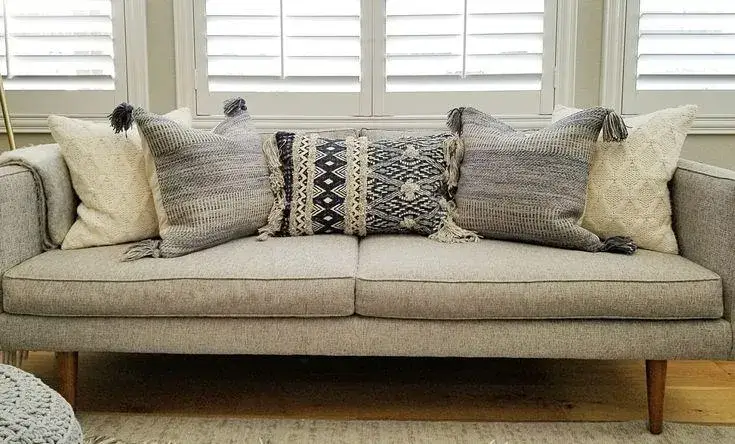
Sofa Arrangement in 6 Steps
- Clear the sofa completely to start with a blank slate.
- Place two large 22×22 solid foundation pillows flush against the armrests.
- Add two 20×20 printed character pillows directly in front of the foundations.
- Place your accent lumbar pillow securely at the center-front.
- Adjust all angles to a relaxed but neat 10–15° inward lean.
- Step back, assess from a distance of 3 feet, and fine-tune as needed.
Bed Arrangement in 7 Steps
- Make the bed completely, pulling the duvet or coverlet taut.
- Place your Euro shams (26×26) upright against the headboard (use 2 for a Queen, 3 for a King).
- Layer your standard shams directly in front of the Euros, using one per sleep side.
- Add 2 decorative 20×20 throw pillows directly in front of the standard shams.
- Center a striking lumbar pillow at the very front of the stack.
- Tuck your actual sleeping pillows out of sight behind the Euro shams, or remove them entirely during the day.
- Step back and check the “slope”—the pillows should taper smoothly from the tallest point in the back to the shortest point in the front.
Outdoor Patio Arrangement in 5 Steps
- Confirm all pillows are specifically weather-rated (look for solution-dyed acrylic or outdoor labels).
- Place heavy 22×22 or 24×24 anchor pillows at the far ends or deep corners of the outdoor sofa.
- Add slightly smaller 20×20 tropical print pillows directly in front of the anchors.
- Add a bright outdoor lumbar pillow right in the center.
- Secure any tie-backs if your outdoor furniture or pillows have them to prevent wind displacement.
Troubleshooting Your Arrangement
Even following the steps perfectly, you might feel something isn't quite clicking. Use these troubleshooting fixes to quickly correct common arrangement issues.
Problem: “The arrangement looks flat and boring.”
Fix: You likely have all the exact same texture across your pillows. Add one velvet, linen, or heavily woven pillow to instantly break the monotony and add depth.
Problem: “The pillows keep falling over or sagging.”
Fix: Your inserts are too small for your covers. Size up by 2 inches per insert. Alternatively, as a quick fix, stuff a small handful of polyester fill into the corners of the cover to add necessary structure.
Problem: “The arrangement looks too formal and stiff.”
Fix: Stop symmetrizing everything. Deliberately move one pillow from the left side to the right, tilt it slightly off-axis, and angle the center lumbar slightly off-center to introduce natural, casual movement.
Problem: “The colors look completely mismatched.”
Fix: You are likely missing a visual connector. Your boldest print pillow in the middle layer should contain ALL of the other colors present in the arrangement. This print serves as the “visual bridge” that makes disconnected colors cohere beautifully.
The 5-Minute Refresh Formula
A beautiful pillow arrangement requires minor maintenance to keep it looking pristine. Perform this quick, 5-minute refresh daily or weekly. First, fluff all pillows vigorously (30 seconds). Next, restack them in the correct back-to-front order (30 seconds). Karate-chop any down-filled pillows to restore the designer indent along the top edge (15 seconds). Straighten all pillows to ensure they share a consistent inward lean (15 seconds). Finally, rotate the position of the lumbar pillow—place it slightly off-center one week, and perfectly centered the next.
Keep It Fresh
Rotate your lumbar pillow to a different position each week. Simply moving it from the dead center to slightly off-center on the left adds immediate visual freshness to the room without requiring you to buy a single new item.
Frequently Asked Questions
How do I arrange pillows on a sofa step by step?
Start with a bare sofa. Place your largest foundation pillows at the armrests first. Add your medium printed character pillows directly in front of them. Finish by placing a centered lumbar pillow in the front. Always build the arrangement back-to-front and largest-to-smallest.
How many pillows do I need for my sofa?
For an 84–90″ standard sofa, 5 pillows is the designer standard (2 large, 2 medium, 1 lumbar). For a large sectional, use 7–9 pillows. For a smaller loveseat, 3–4 pillows provide perfect balance.
Should sofa pillows be symmetrical or asymmetrical?
Both approaches are entirely valid. Symmetry creates formal, traditional elegance, while asymmetry creates casual, modern warmth. Tropical, bohemian, and eclectic styles benefit greatly from deliberate asymmetry.
What order do you put pillows on a sofa?
Always place your foundation pillows (the largest solids) at the back armrests first, followed by your character pillows (the medium prints) in the middle, and finish with your accent lumbar pillow at the front center. Never reverse this sizing order.
How do I keep sofa pillows from looking messy?
Use the 5-Minute Refresh Formula daily: fluff the inserts vigorously, restack the pillows in the proper back-to-front order, re-angle them to a neat 10–15° lean, and reposition the center lumbar. A quick karate chop to the top edges also helps maintain a tidy, designer look.
Conclusion
Creating a magazine-worthy pillow arrangement is not a mystical art form reserved for professionals; it is a highly logical, step-by-step process that is entirely learnable by anyone. The most important habits you can develop are measuring your furniture before you shop, always following the back-to-front placement order, and evaluating your handiwork from a standing, 3-foot distance.
Tropical throw pillows make this process especially rewarding, because a single bold, botanical print pillow contains all the color and energy you need to build an entire room's arrangement around. Start with the formulas provided, follow the steps methodically, and watch your living space transform into a beautifully curated sanctuary.
Once you understand the arrangement process, styling pillows becomes less about guessing and more about creating intentional, beautifully balanced spaces.