Tropical decor has always had a strong identity — bold botanicals, vivid color, exuberant pattern. But what counts as “on trend” within that identity shifts meaningfully from year to year. The tropical look that felt fresh in 2022 can feel dated by 2026. Understanding what's actually trending right now — and why — helps you make smarter buying decisions, whether you're refreshing a single room or building an entirely new aesthetic.
In 2026, tropical pillow trends are moving in a clear direction: larger scale, earthier palette, more textural variety, and a growing commitment to sustainability. At the same time, a bold maximalist counter-movement is pushing back against minimalism with layered prints, vibrant saturated color, and unapologetic abundance. Both directions coexist — and knowing which fits your space matters more than chasing either trend blindly.
This guide covers the ten most significant tropical pillow trends of 2026 — each with a heat rating, design notes, styling guidance, and a verdict on how long each trend is likely to last. You'll also find the color palettes driving the look, the patterns fading out, the rising newcomers, and a practical buying guide for staying on trend without over-spending.
| Looking For | Best Trend |
|---|---|
| Most Durable | Earthy Jungle Palette |
| Biggest Statement | Oversized Botanicals |
| Luxury Look | Embroidered Tropical |
| Budget-Friendly | Dark Botanical Accent |
| Future-Proof | Sustainable Tropical Pillows |
Expert Perspective
The biggest shift in 2026 tropical pillow design is the move from “beach house” to “biophilic.” The reference point has changed from resort poolside to immersive rainforest — deeper greens, more complex layering, moss and fern joining palm and hibiscus. It's a more sophisticated, interior-design-forward tropical than what dominated the last decade.
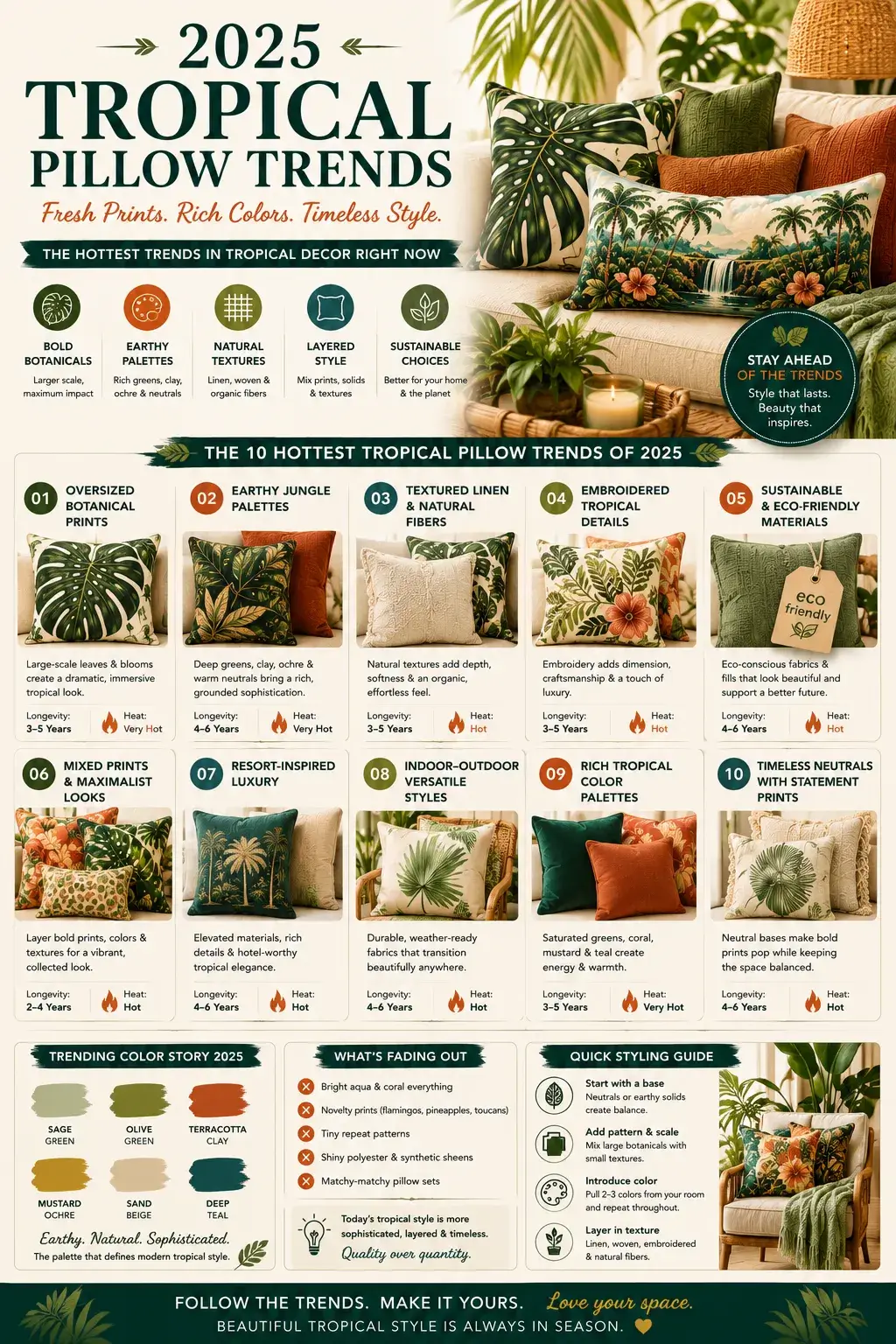
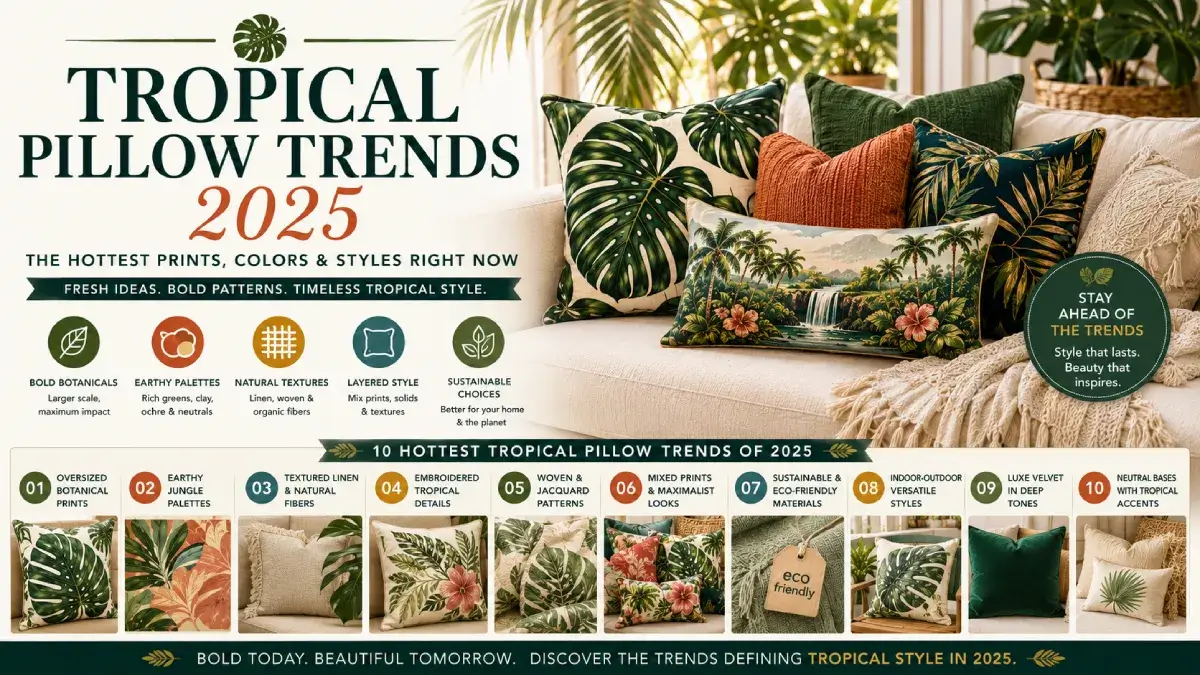
The 10 Hottest Tropical Pillow Trends of 2026
Oversized Botanical Prints
Oversized botanical prints — where a single monstera leaf, palm frond, or bird-of-paradise bloom fills an entire pillow face — are the defining print trend of 2026. These are not the small repeating tropical patterns of years past. The scale is cinematic: one element, dramatically enlarged, rendered in rich detail. The effect is immersive in a way that busy small-repeat patterns never achieve.
This trend is driven by the wider biophilic design movement, which seeks to bring nature visually and psychologically into interior spaces. An oversized botanical print doesn't just suggest tropical — it immerses you in it. A single 22-inch pillow with a full-scale monstera leaf has more visual presence than four smaller-print pillows combined. This scale confidence is exactly what 2026 tropical interior design is leaning into.
Styling note: oversized prints work best as anchor pillows rather than all-over repeats. One or two large-scale botanical pillows, supported by solid coordinates in matching colors, creates a sophisticated arrangement without visual noise.
Trend Heat – Very Hot | Longevity – Strong | Mainstream Reach – Wide
Verdict: This is the most significant tropical pillow trend of 2026 and has genuine staying power. Invest here — oversized botanicals will still look current in 2027.
Earthy Jungle Palettes (Dark Greens, Clay & Ochre)
The bright aqua-and-white tropical palette of the early 2010s is giving way to something richer and more complex. The 2026 tropical color story is dominated by deep forest greens, warm terracotta clay, earthy ochre, aged brass accents, and creamy parchment neutrals. This palette is rooted in the aesthetics of high-end tropical resorts — think Bali boutique hotels and Costa Rican eco-lodges rather than Florida beach rentals.
The shift is significant because it broadens tropical design's appeal beyond coastal settings. An earthy jungle palette works in a Brooklyn loft, a Chicago condo, or an Austin bungalow in a way that turquoise-and-coral never could. The tropical reference is atmospheric rather than literal — it evokes the feeling of deep jungle without requiring a coastal backdrop.
Trend Heat – Very Hot | Longevity – Very Strong | Mainstream Reach – Wide
Verdict: The single most durable color shift in tropical decor. Earthy jungle palettes represent a fundamental repositioning of tropical design — not a passing fad. This will define the look through 2028.
Textured Linen & Natural Fiber Covers
Consumers are rejecting the flat, synthetic feel of budget polyester covers in favor of tactile natural textures. Linen, linen-cotton blends, slubbed cotton, and woven grass-cloth-inspired fabrics are dominating the 2026 tropical pillow market at every price point. The trend is tied to both the biophilic movement and a broader rejection of anything that feels plasticky or overly processed.
Natural textures add a layer of sensory richness that printed polyester can't replicate. When a botanical print sits on slightly slubbed linen, it acquires a hand-made, artistic quality — the slight texture variation makes it look like a nature print on handmade paper rather than a digital file on synthetic fabric. This material-meets-print interaction is exactly what elevated tropical styling in 2026 is about.
Trend Heat – Hot | Longevity – Strong | Mainstream Reach – Growing
Verdict: Natural textures are here to stay. Any pillow with a quality linen or natural-fiber cover will look more current in 2026 than its polyester equivalent at the same print design.
Maximalist Layered Tropical Arrangements
The pendulum is swinging hard against minimalism. Maximalist tropical arrangements — five, six, or even seven pillows in a single sofa arrangement, mixing bold botanical prints, solid jewel tones, and textured coordinates — are among the most widely-shared interior design looks on Pinterest and Instagram in 2026. The aesthetic celebrates abundance: more plants, more print, more texture, more color.
Done well, maximalist tropical layering is visually stunning and creates genuinely immersive spaces. The key discipline is working within a controlled color palette (usually two to three core colors plus neutrals) while varying the pattern scale and texture. Mixing a large-scale monstera print, a medium palm leaf coordinate, and a solid deep green velvet accent creates richness without chaos.
Trend Heat – Hot | Longevity – Moderate | Mainstream Reach – Growing
Verdict: At peak heat right now. Enjoy the moment but don't over-invest — maximalism tends to cycle back toward restraint within 2–3 years. Layer boldly, but choose pieces that can be rearranged rather than replaced.
Fern, Moss & Forest Floor Botanicals
Tropical design is moving beyond the obvious icon species — monstera, palm, hibiscus — into the richer, more complex visual vocabulary of the forest understory. Ferns in their dozens of varieties, moss textures, pitcher plants, philodendron species, and creeping vines are emerging as the new sophisticated botanical vocabulary for 2026 tropical pillows.
This shift reflects a more botanically literate design consumer. Platforms like Instagram and TikTok have educated millions of people about plant taxonomy — they can name a Monstera deliciosa versus a Thai constellation, distinguish a bird-of-paradise from a banana leaf. As botanical knowledge has grown, so has demand for more specific, nuanced plant imagery on home furnishings.
Trend Heat – Rising Fast | Longevity – Strong | Mainstream Reach – Niche → Mainstream
Verdict: A rising trend with a strong aesthetic rationale. Fern and forest-floor botanical prints are the sophisticated evolution of tropical design — buy now before they hit peak saturation.
Sustainable & Eco-Conscious Tropical Pillows
Sustainability has moved from a niche concern to a mainstream purchasing driver in home textiles. In 2026, a significant and growing segment of tropical pillow buyers actively seek out organic cotton, GOTS-certified fabrics, recycled polyester covers, kapok fills, and brands with verifiable supply-chain transparency. This isn't just a trend — it's a structural category shift that is permanently reshaping how tropical pillows are made and marketed.
The aesthetic implication is interesting: sustainable tropical pillows tend to skew toward natural tones, organic textures, and earthy palettes — which perfectly aligns with the dominant color trend. An organic cotton linen-blend cover in deep forest green with a botanical print sits at the exact intersection of sustainability and style leadership for 2026.
Trend Heat – Hot & Growing | Longevity – Permanent Shift | Mainstream Reach – Wide & Widening
Verdict: Not a trend to chase — a direction to align with. Sustainable tropical pillows will be the default in 3–5 years. Moving toward sustainable choices now is simply being early rather than late.
Embroidered & Handcrafted Tropical Details
Mass production saturation is driving a counter-movement toward the handcrafted. Embroidered tropical pillows — thread-stitched monstera leaves, hand-worked hibiscus, intricate woven palm motifs — are experiencing a significant revival in 2026. The appeal is the visible evidence of human making: the slight imperfections, the dimensional texture, the sense that a skilled person spent time on this object.
This trend intersects with the “slow living” and “collected over time” aesthetic movements that are influencing millennial and Gen X home buyers. A home that looks as though it was assembled over years through thoughtful discovery — rather than ordered all at once from a single retailer — has become a strong aspirational aesthetic. Embroidered and artisan tropical pillows signal exactly that sensibility.
Trend Heat – Strong | Longevity – Strong | Mainstream Reach – Mid-Market Up
Verdict: A reliable long-play trend. One or two embroidered pieces anchor an arrangement with a quality signal that mass-produced prints cannot match at any price point.
Moody Dark-Background Tropicals
Dark-background tropical prints — botanical designs set against deep navy, charcoal, black, or dark forest green grounds — are one of the strongest rising visual trends in 2026 pillow design. The effect is the reverse of the classic white-background tropical: instead of light botanical forms against bright white, vivid botanical colors explode against a dark, moody ground. The result is richer, more dramatic, and fundamentally more sophisticated.
Dark-background tropicals work best in rooms with adequate natural light, where the contrast can be appreciated without feeling cave-like. In a well-lit living room or bedroom with white walls, a cluster of dark-background tropical pillows creates an anchor of depth and drama that bright-background designs simply cannot provide.
Trend Heat – Very Hot | Longevity – Moderate to Strong | Mainstream Reach – Growing
Verdict: One of the highest-impact visual choices in 2026 tropical design. Two dark-background botanical pillows transform an arrangement more dramatically than almost any other single purchase.
Coastal Grandmother & Relaxed Resort Tropical
The “coastal grandmother” aesthetic — sun-bleached linens, wicker furniture, faded tropical prints, porch rocking chairs — has been building for several years and remains strongly present in 2026. For tropical pillows, it translates into vintage-looking botanical prints, slightly desaturated color palettes, and fabrics that feel worn-in and comfortable rather than crisp and new.
This trend is the antidote to the high-gloss, high-saturation tropical look of the Instagram era. It values imperfection, age, comfort, and unpretentious elegance. Think a faded cotton-linen blend with a soft palm print in muted jade and cream rather than vivid emerald and stark white. Think pillows that look as if they've spent happy summers on a screened porch for the past twenty years.
Trend Heat – Strong | Longevity – Moderate | Mainstream Reach – Wide
Verdict: Culturally strong but passing peak. Great for a room that suits this aesthetic — but don't invest heavily if this is purely trend-chasing rather than a genuine aesthetic match for your home.
Indoor–Outdoor Tropical Continuity
The boundary between indoor and outdoor living continues to dissolve in 2026 home design. The result for tropical pillows is a strong trend toward visual continuity: using the same botanical prints, color palette, and styling language from the living room through the sunroom to the patio. The home becomes a single unified tropical environment rather than separate themed spaces.
Enabling this trend are advances in outdoor performance fabrics that now replicate the look and texture of indoor textiles so closely that the average eye cannot tell them apart. Solution-dyed acrylic covers with linen-like textures and vibrant botanical prints make it possible to maintain visual continuity across the indoor–outdoor boundary without sacrificing durability where it's needed most.
Trend Heat – Hot | Longevity – Very Strong | Mainstream Reach – Growing Fast
Verdict: A structurally driven trend that will continue to grow as open-plan indoor–outdoor homes become more common. Invest in this direction for long-term relevance.
Trend Heat Summary: At a Glance
| Trend | Heat Level | Longevity | Best Action |
|---|---|---|---|
| Oversized Botanical Prints | 🔥 Very Hot | Strong (3–5 yrs) | Invest now |
| Earthy Jungle Palettes | 🔥 Very Hot | Very Strong (4–6 yrs) | Invest now |
| Textured Linen Covers | 🔥 Hot | Strong (3–5 yrs) | Invest now |
| Maximalist Layering | 🔥 Hot | Moderate (2–3 yrs) | Enjoy now, don't over-invest |
| Fern & Forest Botanicals | ↑ Rising Fast | Strong (3–4 yrs) | Buy early |
| Sustainable Pillows | ↑ Hot & Growing | Permanent | Align with this |
| Embroidered Tropical | ↑ Strong | Strong (3–5 yrs) | One or two pieces |
| Dark-Background Tropicals | 🔥 Very Hot | Moderate–Strong | High-impact purchase |
| Coastal Grandmother | ↑ Strong | Moderate (2–3 yrs) | Only if it fits your space |
| Indoor–Outdoor Continuity | 🔥 Hot | Very Strong (4–6 yrs) | Invest for patio/sunroom |
What's Fading Out in 2026
Understanding what's declining is as important as knowing what's rising. Buying into a fading trend means your investment looks dated within months rather than years.
Fading Trends to Avoid Over-Investing In
- Bright aqua and coral palettes
Fading — the quintessential 2010s beach-house tropical is now reading as dated in most interior contexts. A few carry-overs survive, but widespread investment here is a style risk.
- All-white background small-scale repeat patterns
Fading — the tiny-print-on-white tropical that dominated big-box home stores from 2015–2022 feels formulaic and overexposed in 2026.
- Flamingo and toucan novelty prints
Fading — novelty tropical wildlife that peaked as Instagram props in 2018–2020. Still available everywhere, but increasingly associated with the dated phase of the trend.
- Shiny polyester covers with over-bright prints
Fading — the budget polyester tropical with oversaturated, almost neon color is losing ground to both natural textures and more sophisticated color palettes.
- Matchy-matchy tropical sets
Fading — buying four identical pillows from a matching set reads as less sophisticated than a thoughtfully mixed arrangement. Coordinated variety has replaced uniformity.
The 2026 Tropical Color Story
Color is the fastest-moving dimension of any decor trend. The 2026 tropical palette is defined by depth, earthiness, and botanical authenticity — moving away from synthetic-feeling brights toward colors that could actually be found in a real forest or garden.
Rising Accent Colors
Dried Blush
A muted, dusty pink — less candy, more dried botanical. Works beautifully with deep greens and earthy neutrals.
Aged Indigo
A desaturated, slightly faded blue. More historic than vivid aqua — references indigo-dyed textiles and works as a sophisticated accent.
Warm Amber
Golden amber and honey tones, referencing dappled light filtering through a jungle canopy. Works as a warm highlight color.
Mushroom Neutral
A warm greige-brown that bridges botanical prints and neutral furniture — the ideal background neutral for 2026 tropical arrangements.
Fading Colors (Reduce Investment)
Pattern Trends: What to Buy and What to Skip
| Pattern Type | 2026 Status | Best Styling Use | Longevity Outlook |
|---|---|---|---|
| Oversized single botanical | Rising ↑ | Anchor pillow in any arrangement | 3–5 years |
| Dark-background botanical | Rising ↑ | Drama/depth accent | 2–4 years |
| Fern & understory plants | Rising ↑ | Sophisticated botanical layer | 3–4 years |
| Embroidered botanical | Peak | Feature display piece | 3–5 years |
| Palm + monstera blend | Peak | Classic tropical staple | 2–3 years |
| Small-scale white-background repeat | Fading ↓ | Coordinate only | 1–2 years |
| Flamingo & novelty wildlife | Fading ↓ | Avoid as investment piece | Under 1 year |
| Hibiscus flower close-up | Late Peak | Still works as accent | 1–2 years |
How to Build a Trend-Forward Tropical Arrangement in 2026
Knowing what's trending is only useful if you can translate it into actual purchases and arrangements. Here's a practical framework for building a 2026-forward tropical pillow collection without overspending or over-committing to passing trends.
1. Anchor with one oversized botanical print
Choose one 22–24 inch pillow in a large-scale botanical print on a natural linen or cotton canvas ground. This is your arrangement's visual center and your most trend-forward piece. Lean toward earthy colors: deep greens, terracotta, ochre. This single piece establishes your 2026 credentials more than any other purchase.
2. Add a dark-background botanical for depth
An 18–20 inch pillow with a vivid botanical print against a dark navy, charcoal, or forest-green ground adds dramatic depth. This piece creates visual contrast with your light-ground anchor and adds the sophistication that separates 2026 arrangements from earlier years.
3. Ground with solid jewel-tone coordinates
Two smaller solid pillows in colors pulled from your botanical prints — deep emerald, terracotta, ochre — provide visual rest and tie the palette together. Velvet or linen textures in solid colors are the preferred material choice here. These are the pieces that prevent an arrangement from feeling like a pattern overload.
4. Add one tactile statement piece
One embroidered, tufted, or woven tropical piece adds the handcrafted artisanal quality that elevates the entire arrangement. This doesn't need to be large — a 14-inch embroidered accent or a woven botanical pattern speaks the artisan trend fluently even at small scale.
5. Extend the palette outdoors (if applicable)
If you have outdoor seating, choose weather-resistant versions in coordinating colors and prints to create the indoor–outdoor continuity trend. Solution-dyed acrylic covers in the same palette create a unified experience across your living space.
Trend-Smart Budget Allocation
Spend 60% of your pillow budget on pieces that align with long-longevity trends (oversized botanicals, earthy palette, linen textures). Reserve 30% for the high-heat shorter-trend pieces (dark backgrounds, maximalist variety). Keep 10% flexible for whatever captures your eye — personal resonance outlasts trend forecasts.
The 2026 Tropical Trend Forecast: What's Coming Next
Emerging Directions for 2026 and Beyond
Based on the trajectory of 2026's leading trends, these are the directions likely to gain significant momentum in 2026:
- Mycological tropicals: Mushrooms, fungi, and lichen joining botanical vocabularies — the “garden of the forest floor” expanding from ferns into fungi.
- Heritage botanical illustration: 18th–19th century scientific botanical illustration aesthetics — think Audubon-style detailed specimens on aged-paper grounds.
- Tactile tufting and 3D texture: Tufted, looped, and sculptural tropical pillow covers where the design exists in three dimensions rather than printed on a flat surface.
- Regional tropical specificity: Moving beyond generic “tropical” to specifically Caribbean, Southeast Asian, Hawaiian, or Amazonian visual vocabularies — each with distinct color palettes and plant species.
- Upcycled and vintage tropical textiles: Recut vintage tropical fabric and reclaimed textiles repurposed as pillow covers — authentically aged rather than aged-looking.
The best trends aren't the ones everyone copies—they're the ones that complement your home's personality and stand the test of time. Focus on quality materials, timeless botanical motifs, and layered natural textures, and your tropical décor will remain stylish long after seasonal trends have passed.
Trend-Shopping FAQ
What is the biggest tropical pillow trend for 2026?
Oversized botanical prints on natural-textured fabrics in earthy jungle palettes — deep greens, terracotta, and ochre — is the defining aesthetic of 2026 tropical pillow design. This direction combines several aligned trends (scale, color, material) that are all moving in the same direction simultaneously, making it particularly powerful and likely to have lasting influence.
Are tropical pillows still on trend in 2026?
Yes — strongly. Tropical design is not a passing micro-trend; it's a major decor category that has maintained relevance for decades while evolving aesthetically. The 2026 version of tropical is more sophisticated, more materially nuanced, and more broadly applicable than any previous iteration. It's not a question of whether tropical is “still” on trend — it's a question of which direction within tropical is currently leading.
Are bright aqua and coral tropical pillows out of style?
They're fading as the dominant palette — the bright aqua-and-coral combination reads as a 2010s beach-house reference in 2026. Individual pieces in these colors can still work in the right context, but building an entire new arrangement around this palette is a style risk. Shifting toward deeper greens, terracotta, and ochre is the contemporary direction.
What tropical pillow patterns are most popular in 2026?
Oversized single-specimen botanical prints (monstera, palm, bird-of-paradise at large scale), dark-background botanical designs, and fern and understory plant patterns are the most design-forward choices in 2026. Embroidered tropical patterns maintain strong appeal as statement pieces. Small-scale white-background repeat patterns and novelty wildlife prints (flamingo, toucan) are the weakest performers.
How often should I update my tropical pillows to stay on trend?
A practical framework: treat solid-color coordinate pillows as foundational pieces that stay for 4–6 years, large-scale botanical anchors as 3–5 year investments, and smaller accent pieces as the seasonal-refresh layer you update every 1–2 years. This way you're always adding something current without wholesale replacing your investment pieces.
Are maximalist tropical arrangements overdone?
At peak saturation on social media in 2026, but not yet overdone in real homes. The key is executing maximalist layering with genuine design discipline — controlled palette, varied pattern scale, quality materials — rather than simply piling on as many tropical prints as possible. Done correctly, it reads as curated abundance rather than clutter.